
How to Advertise on HARO: A Step-by-Step Guide to HARO Ads

HARO ads are text placements in HARO’s free journalist-request newsletter, sold self-serve at published rates to companies that want to reach PR professionals, publicists, marketers, founders, and subject matter experts. You can book a single edition or a month of placements, write the ad in your browser, and pay by card. HARO staff read every ad before it runs.

This guide explains who reads HARO, why HARO sells ads, the three placements and their specs, the advertising guidelines, current rates, the booking steps, and what happens after you submit.

Who reads HARO?

HARO delivers journalist requests to subscribers in three weekday editions: Morning at 5:35 a.m. ET, Afternoon at 12:35 p.m. ET, and Evening at 5:35 p.m. ET. Over the past year, HARO sent more than 100 million emails.

The people opening those emails are PR professionals, publicists, marketers, founders, and subject matter experts who want to be quoted in the press. Advertisers typically promote products and services built for that audience: PR and marketing software, media databases, agency services, research reports, events and conferences, courses, and other newsletters.

Why does HARO sell ads?

HARO is free for PR professionals to receive and use: there’s no charge to receive the newsletter or pitch journalists. Advertising is what makes that free access possible.

Other platforms in this category fund themselves with subscriptions charged to PR professionals. HARO’s model puts the cost on companies that want to reach the audience instead of on the audience itself. That is also why HARO publishes its rates: an advertiser should be able to see the price and book without a sales conversation.

What are HARO ads?

HARO ads are paid, text-only placements that appear inside HARO’s editions. Businesses use them to promote products, services, reports, events, newsletters, and other offers to HARO readers.

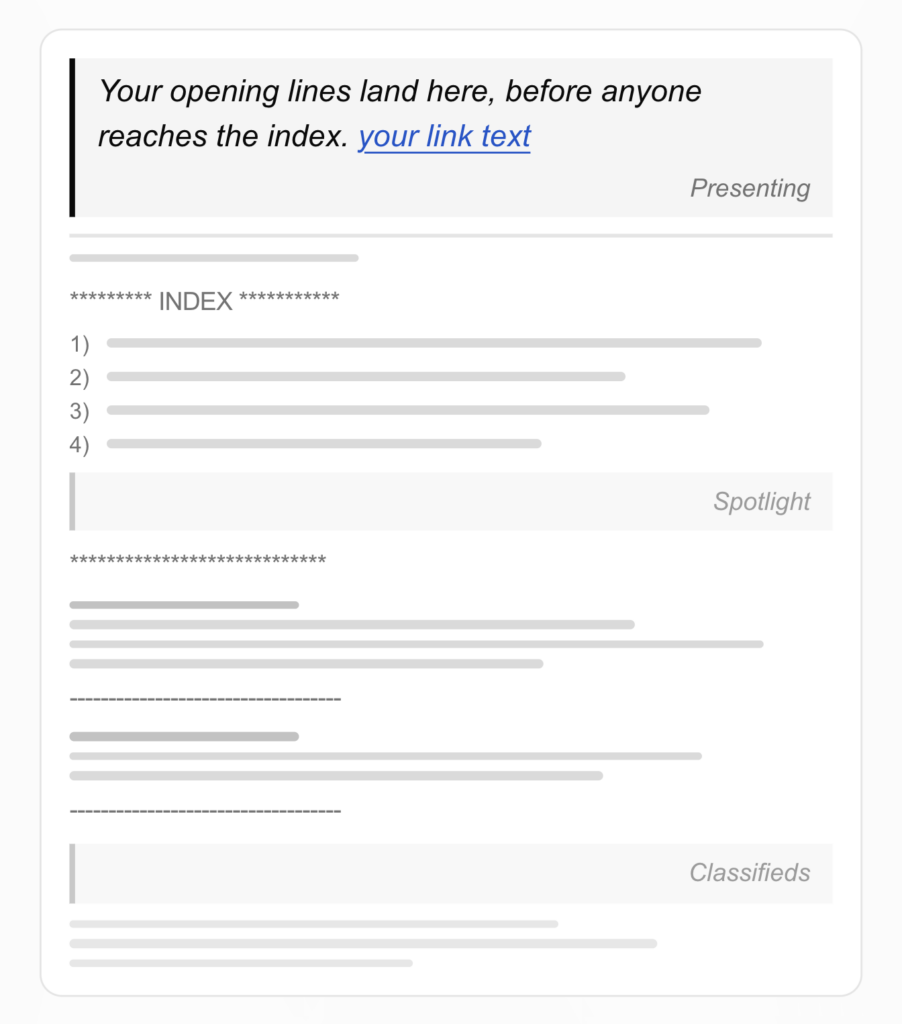
There are three placements: Presenting, Spotlight, and Classified. Each has its own position in the edition and its own character limits.

You can buy one placement or several across different editions and dates.
What are the HARO ad specs?

Every HARO ad is plain text. Each ad has body copy and link text, plus one destination URL that begins with https://. Images and HTML are not accepted.

PlacementAd copyLink textWhere it appearsLabel in the edition
Presenting Up to 350 charactersUp to 30 charactersTop of the edition, above the journalist query indexPresenting
SpotlightUp to 350 charactersUp to 30 charactersBelow the query index, above the first journalist querySpotlight
ClassifiedUp to 140 charactersUp to 24 charactersClosing Classifieds block after the last query. Up to three listings per editionClassifieds

What are the HARO advertising guidelines?

HARO reviews every advertisement before publication. Use this checklist before you submit.

Your ad should:

  • Name the company and clearly describe the product or offer being promoted.
  • Link to a page that is about the offer in the ad.
  • Use a destination URL that begins with https://.
  • Make claims about results or reach specific enough for a reader to verify.
  • Mention a money-back guarantee only if it applies to the advertiser’s own product or service.

Your ad cannot:

  • Promise a story or media coverage.
  • Imply that payment purchases or guarantees editorial coverage.
  • Describe a HARO ad placement as guaranteed press.
  • Sell links.
  • Name a publication in a way that makes a paid advertisement look like news or editorial content.
  • Imply that HARO wrote, approved, endorses, or recommends the advertiser or its offer.

Destination URL requirements:

  • The URL must begin with https://.
  • The destination should be a page about the offer promoted in the ad.
  • Paywalled, checkout, and signup pages are more likely to be returned for revision.

Good to know:

  • Your receipt and review decision, plus any revision requests, go to the work email provided with the order.
  • You do not need a HARO account to purchase an ad.
  • Use a work email associated with the company in your ad. If the email address does not match the company being advertised, the order may receive extra scrutiny.

How much does it cost to advertise on HARO?

HARO advertising rates depend on the placement, edition, and weekday you choose. The table below shows Thursday base rates. Monday through Wednesday are priced above the Thursday rate and Friday is priced below it, so Friday is the lowest-priced day on the card. The booking calendar shows the actual price for every open date. The lowest-priced placement is a Friday Evening Classified at $105.

PlacementMorningAfternoonEvening
Presenting $795$625$525
Spotlight$395$315$265
Classified$195$155$125

A la carte orders receive automatic volume discounts: 10% for 4 or more placements, 15% for 8 or more, 22% for 16 or more, and 28% for 30 or more.

HARO also offers fixed-price bundles:

BundleWhat it includesPrice
Try HAROFour Classified placements, Afternoon edition$450
Spotlight WeekFive Spotlight placements, Morning edition$1,595
Presenting WeekFive Presenting placements, Morning edition$3,195
Classified Month20 Classified placements, any edition$2,395
Full Month PresenceFour Presenting, eight Spotlight, and 20 Classified placements$6,450

Bundle discounts are already included in the listed prices and do not stack with volume discounts.

How to advertise on HARO

Step 1: Choose your placement and dates
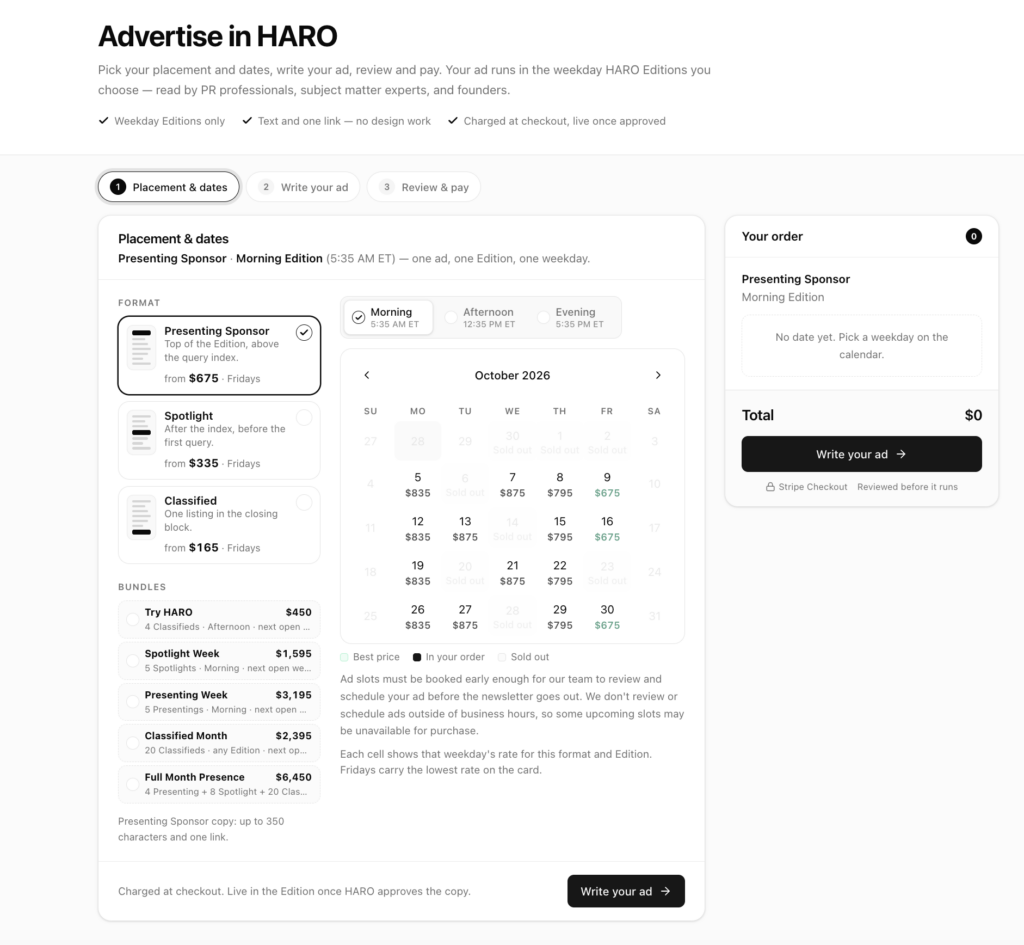
Go to helpareporter.com/advertise. Select the placement you want, then the edition and publication date. Ads run in weekday editions only.

You can buy a single placement or select several dates and editions in one order. The calendar shows the price for each open date up to 45 days ahead. Dates that are too close to send time or already sold are unavailable. You can also pick one of the bundles if you want to run several placement types.

Step 2: Write your ad
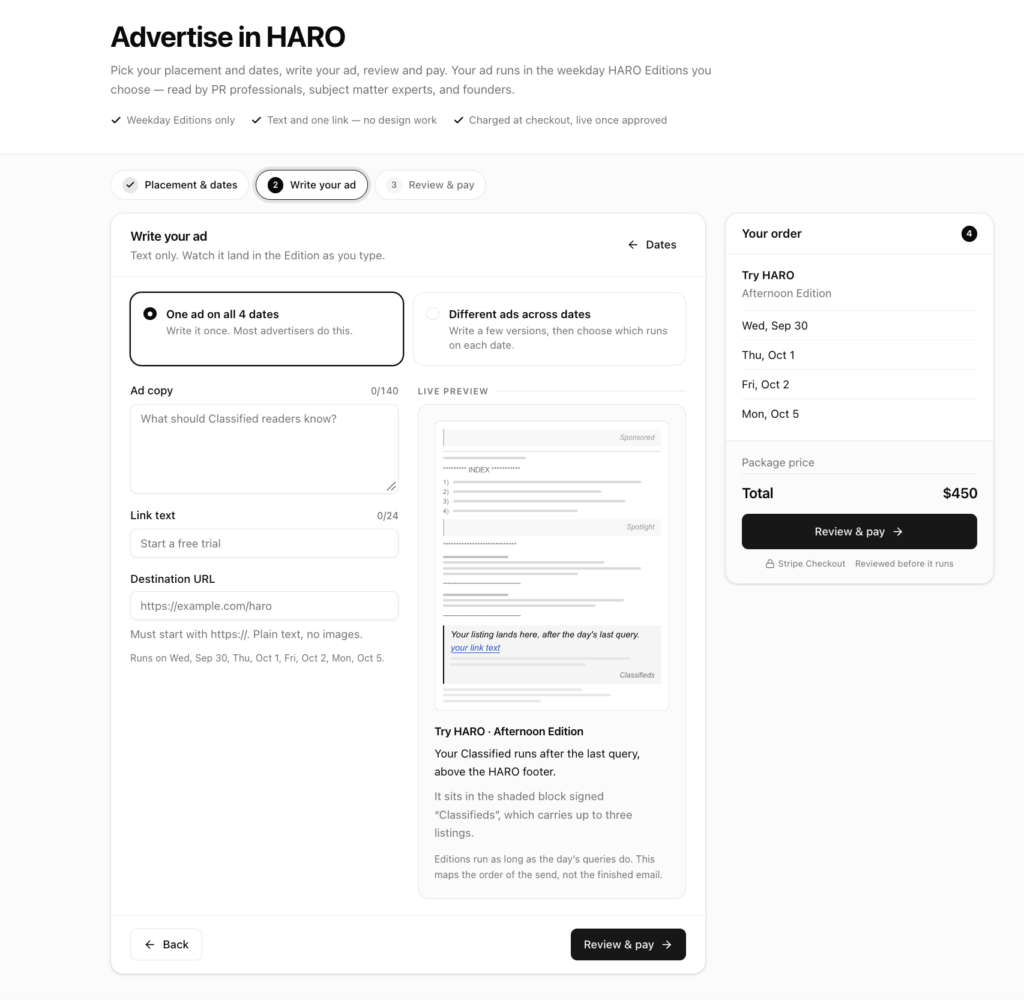
Enter your ad copy and link text, then add one destination URL. A live preview shows where the ad lands in the edition as you type. Check your copy against the specs and guidelines above.

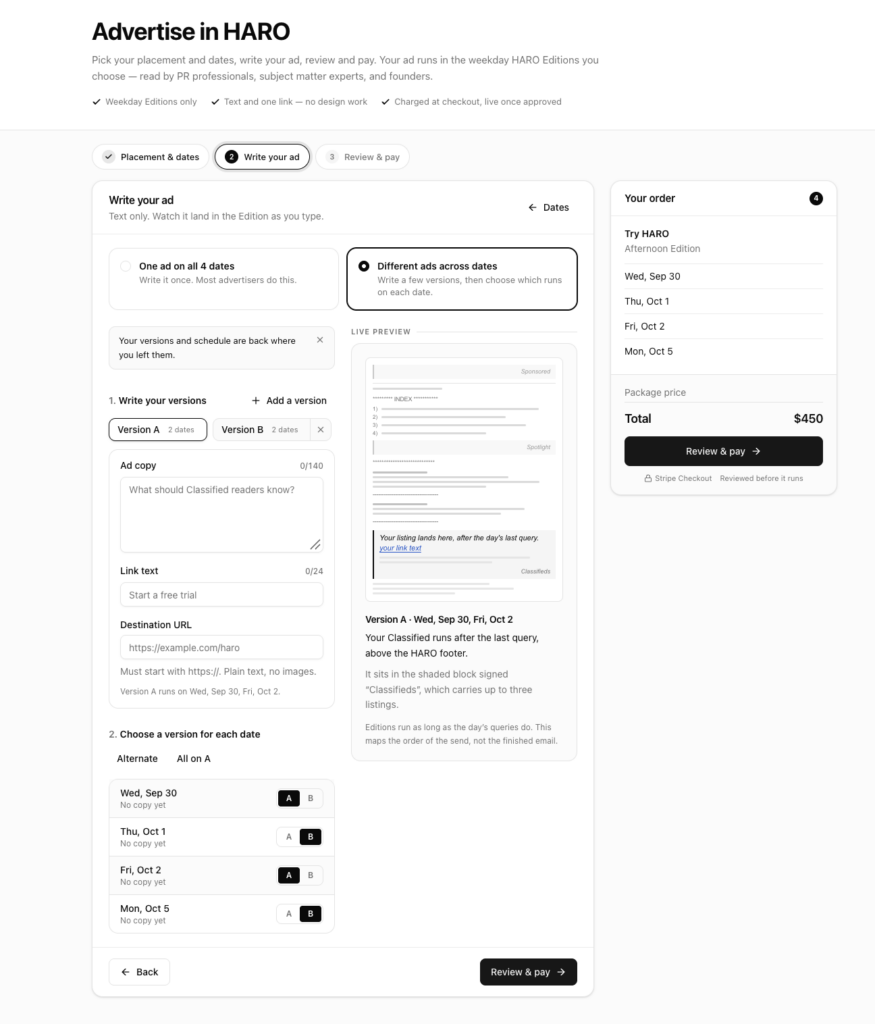
If your order includes more than one send, you can write several versions of the ad and choose which version runs on each date. You can use one version everywhere or alternate versions across dates. A version that is not assigned to a date is not saved.
Step 3: Review your order and pay
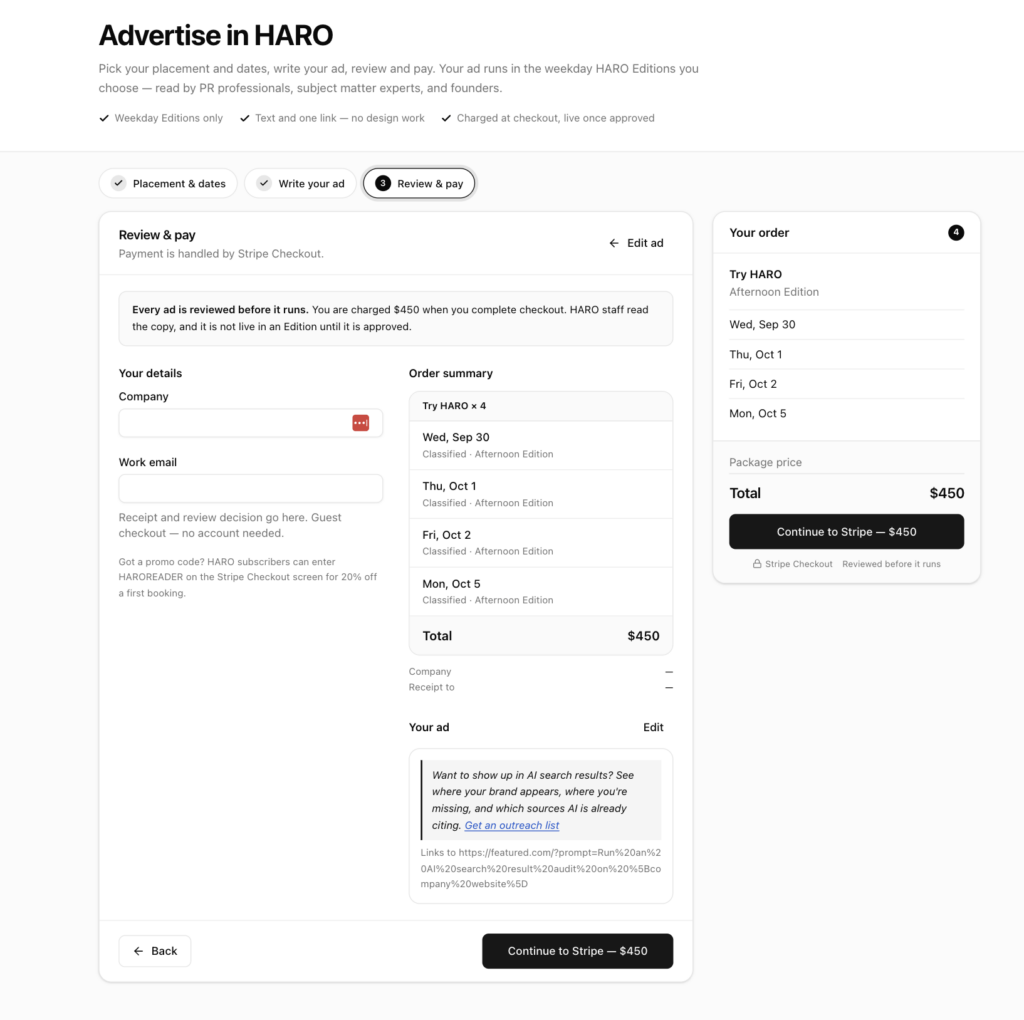
Review your placements, dates, editions, and ad copy, then complete checkout. Payment is handled by Stripe Checkout, and you do not need a HARO account.

First-time advertisers can enter the code HAROREADER on the Stripe Checkout screen for 20% off a first booking.

After payment, you receive an email confirming that your ad was purchased and submitted for review. Once your ad is approved and scheduled, a second email confirms the edition and date.

What happens after you submit a HARO ad?

HARO needs lead time between booking and publication to review and schedule ads. Ads are not reviewed or scheduled outside business hours, so some upcoming editions may be unavailable at checkout.

If your ad meets the guidelines, HARO approves it and schedules it for the selected edition and date.

If HARO requests changes, the work email on the order receives a message explaining what needs to change and the revision deadline. Advertisers can request up to two rounds of revisions.

The revision deadline is one full weekday before the first scheduled send, at the same Eastern time the edition goes out. Weekends do not count. An ad scheduled for a Monday edition, for example, must have its revision submitted by the same time on the previous Friday.

A reminder is sent about one day before the deadline if the update has not arrived. Use the link in the revision email to make changes. If an order contains several ad versions, update each version named in the email.

If the revision deadline passes, or HARO declines the advertisement, the order is cancelled and the charge is refunded. Refunds typically arrive within 5 to 10 business days.

HARO Advertising FAQ

Yes. HARO is free for journalists to post requests and free for sources to receive and answer them. HARO is supported by advertising rather than by subscription fees charged to PR professionals.

PR professionals, publicists, marketers, founders, and subject matter experts who want to be quoted in the press. HARO sent more than 100 million emails to subscribers in the past year.

Each ad can include one destination URL, which must begin with https://.

Yes. When an order includes several sends, you can write several ad versions and assign them to specific dates and placements. Several dates can share the same version.

No. Every placement runs to the full edition list.

No. You can purchase a HARO ad without creating or having a HARO account.

Yes. Every HARO advertisement is reviewed by HARO staff before publication.

The advertising calendar shows available editions up to 45 days ahead. Dates that are too close to send time or already sold are closed.

Ads need at least one business day before publication for review and scheduling. If HARO requests revisions, the advertiser receives a deadline by email, and the ad must be approved before that deadline to run as scheduled.

If HARO declines an advertisement, the order is cancelled and the charge is refunded. Refunds typically arrive within 5 to 10 business days.

7 Reasons Why Business Awards Are Important and How to Find the Right Ones

Businesses should apply for awards because credible recognition can strengthen brand credibility, generate PR opportunities, support marketing and sales, differentiate a company from competitors, and provide independent validation of business achievements.

But not all business awards are equal, and winning an award does not automatically make a company more successful. The value of recognition depends on the organization presenting the award, the judging process, the relevance of the category and the audience that recognizes it.

Research does suggest that certain types of business awards can be associated with meaningful business outcomes. Studies have found relationships between awards and measures including sales growth, return on equity, return on assets, customer perceptions and firm value. The findings vary by award type and industry, making award selection an important part of the process.

For PR and marketing teams, the question is not simply whether a business should enter awards. It is why business awards matter, which opportunities are worth pursuing and how recognition can be used after an award is won.

1. Awards provide third-party credibility

One of the primary reasons businesses apply for awards is to gain third-party credibility through external recognition.

Companies regularly make claims about innovation, quality, customer service, growth and industry leadership. Recognition from an independent organization provides an external signal that can validate and strengthen those claims.

For businesses, this can make an award a useful credibility asset across PR, marketing, sales and brand communications.

2. Awards can create new PR opportunities

Business awards can provide a legitimate news angle for companies that need new ways to generate media attention.

A win can support a press release, media pitch, executive interview, company announcement or customer story. Recognition can also give journalists a reason to revisit a company that may not otherwise have a timely news hook.

For PR teams, the value is that the recognition is based on an existing achievement. An award can turn that achievement into a broader story rather than requiring a company to manufacture a news angle.

3. Awards provide reusable marketing assets

The value of an award does not end when the winner is announced.

Recognition can be incorporated into websites, social media, email campaigns, sales presentations, proposals, customer communications, recruiting materials and other marketing channels.

Research into third-party trust signals provides evidence for the broader principle behind this approach. One study analyzed 288,169 shopping transactions across 493 online retailers and found that third-party trust seals could increase the likelihood of purchase completion, particularly for smaller retailers and newer shoppers. 

4. Awards can differentiate a business from competitors

In competitive markets, companies often make similar claims about quality, expertise, innovation and results. An award can give a business a specific, independently recognized achievement that helps it stand out from competitors.

Research suggests this recognition can have measurable business value. A peer-reviewed study of industrial awards found that operational awards were associated with higher return on equity during the growth stage, while new product awards were associated with business growth. As products matured, supplier and product awards were also associated with return on equity. 

5. Awards can strengthen customer perceptions

Third-party recognition can provide customers with another signal when evaluating competing businesses.

This can be particularly relevant when customers cannot easily assess the quality of a product or service before making a purchase. An award from a respected industry organization, publication or professional association can provide additional evidence of expertise or performance.

6. Awards can support recruiting and employer branding

Business awards can also have value beyond customers and prospects.

Recognition can provide evidence of company achievements for careers pages, job postings, recruiting campaigns and internal communications. For growing companies, external recognition can help communicate the organization’s progress and reputation to prospective employees.

The strongest recruiting value is likely to come from awards that reflect attributes employees actually care about, such as workplace culture, innovation, leadership or employee experience.

7. Awards can provide competitive intelligence

The process of researching awards can reveal what an industry considers noteworthy.

Award categories, judging criteria and previous winners can show which competitors are receiving recognition and which types of achievements are being rewarded. This information can help PR and marketing teams identify trends, competitive strengths and potential gaps in their own positioning.

Previous winners can therefore provide useful context. They show not only which companies are being recognized, but also the achievements and characteristics that helped them stand out.

How to Find the Right Business Awards

Once the value of awards is established, the next challenge is identifying opportunities that are credible and relevant.

Five factors are particularly important:

Relevance: The award should align with the company’s industry, business model, function or achievement.

Credibility: The organization presenting the award, judging process and previous winners should be evaluated.

Audience: Recognition is more valuable when the award is known by customers, prospects, employees, partners or other relevant audiences.

Cost: Entry fees and application resources should be weighed against the potential value of the recognition. Free business awards and programs with no entry fee can also provide worthwhile opportunities.

Timing: Deadlines should allow sufficient time to gather evidence, develop the application and obtain supporting materials.

The challenge is that this information is often distributed across industry associations, publications, professional organizations, events and individual award websites. Researching business awards can therefore become a significant administrative task.

However, Featured’s Find Awards helps consolidate that research by allowing PR professionals, marketers and business owners to describe the recognition they are looking for in plain language. The tool searches a database of 4,596 awards and recognition opportunities and provides information including award names, sponsors, deadlines, entry costs, locations, industries, eligibility and previous winners.

Teams can also create workflows based on their criteria and receive new award opportunities by email or Slack on a daily, weekly, monthly or custom cadence.

The objective is not to enter the greatest possible number of awards. It is to identify the awards that are credible, relevant and aligned with the company’s business and PR goals.

The Bottom Line

Business awards can serve several functions beyond recognition. They can provide third-party credibility, create PR opportunities, strengthen marketing and sales materials, differentiate a company, support customer trust, contribute to employer branding and provide insight into competitive positioning.

The available research suggests that some types of awards are associated with stronger financial and market outcomes, but those findings vary by award type and should not be interpreted as proof that winning an award causes business growth.

For that reason, an effective awards strategy starts with selectivity. The most valuable recognition is not necessarily the most prestigious-sounding award. It is the recognition that is credible, relevant to the business, and meaningful to the audience the company wants to reach.

HARO Submission Guidelines & Requirements

HARO allows journalists, content creators, and qualified media outlets to submit source requests provided they meet the following guidelines:

1. Credible Media Outlet

  • The outlet must be fully launched, with a live domain, recent content, and a verifiable editorial presence.
  • Outlets must have a minimum Domain Authority of 20 or receive at least 10,000 monthly visitors (via Moz, Ahrefs, or internal HARO review).
  • Podcasts must be published on a recognized platform (e.g., Apple Podcasts, Spotify). Podcasts that are only hosted on a company’s website will not be accepted. 
  • Social media posts on a reputable platform (e.g., LinkedIn, X, Bluesky) must be published from a public profile with at least 5,000 followers and demonstrate clear editorial intent or thought leadership.
  • Medium and Substack blogs must have at least 5,000 followers/subscribers.
  • Proof of contributor status must be publicly available, either on the media outlet’s website or linked from the journalist’s personal site or social media profiles.

2. Transparent and Relevant Queries

  • The name of the media outlet must be included in the submission.
  • Query requests must ask for content responses of no more than 3,000 words.
  • Reporters may not link to outside surveys, blog comments, or data capture forms. All responses must go through HARO.
  • No guest blogging, link exchanges, or backlink solicitation is allowed.
  • No requests for monetary compensation from sources are permitted.

3. Restrictions and Prohibited Use

  • Student reporters may only submit if part of an accredited journalism program with faculty endorsement.
  • No subscription-only content is allowed. The public must be able to view published stories without paywall access.
  • Product sample requests are only accepted from verified, reputable outlets or creators. Samples must be returned unless otherwise agreed to by the sender.
  • Gift bag queries are only allowed for confirmed in-person or high-profile digital events. Sponsorships, pay-to-play opportunities, or solicitations for paid placements are prohibited.
  • No online gambling sites are permitted.
  • No data collection, business lead sourcing, or testimonial/review farming is allowed on our platform.
  • Queries must never require pre-recorded video. Experts may optionally provide one, but it must not be mandatory.
  • Story pitches and business/client solicitation within the query submissions will be marked as spam. 

Guidelines Subject to Change

These guidelines are intended to help maintain quality, clarity, and alignment with the platform’s standards. However, they are not exhaustive and are subject to change at any time without prior notice. We encourage you to review this page regularly for the most up-to-date information.

HARO maintains a strict one-strike policy for any violations of our submission guidelines. Our company reserves the right to approve, reject, edit, or remove any submission, query, or content at our sole discretion—regardless of whether it fully meets the guidelines outlined here. Adherence to these guidelines does not guarantee query approval. 

By submitting a query on helpareporter.com (HARO), you acknowledge and agree to these terms.

Note: The HARO team reviews and schedules query submissions 8 am – 5 pm  MST Mon -Fri.