
HARO ads are text placements in HARO’s free journalist-request newsletter, sold self-serve at published rates to companies that want to reach PR professionals, publicists, marketers, founders, and subject matter experts. You can book a single edition or a month of placements, write the ad in your browser, and pay by card. HARO staff read every ad before it runs.
This guide explains who reads HARO, why HARO sells ads, the three placements and their specs, the advertising guidelines, current rates, the booking steps, and what happens after you submit.
Who reads HARO?
HARO delivers journalist requests to subscribers in three weekday editions: Morning at 5:35 a.m. ET, Afternoon at 12:35 p.m. ET, and Evening at 5:35 p.m. ET. Over the past year, HARO sent more than 100 million emails.
The people opening those emails are PR professionals, publicists, marketers, founders, and subject matter experts who want to be quoted in the press. Advertisers typically promote products and services built for that audience: PR and marketing software, media databases, agency services, research reports, events and conferences, courses, and other newsletters.
Why does HARO sell ads?
HARO is free for PR professionals to receive and use: there’s no charge to receive the newsletter or pitch journalists. Advertising is what makes that free access possible.
Other platforms in this category fund themselves with subscriptions charged to PR professionals. HARO’s model puts the cost on companies that want to reach the audience instead of on the audience itself. That is also why HARO publishes its rates: an advertiser should be able to see the price and book without a sales conversation.
What are HARO ads?
HARO ads are paid, text-only placements that appear inside HARO’s editions. Businesses use them to promote products, services, reports, events, newsletters, and other offers to HARO readers.
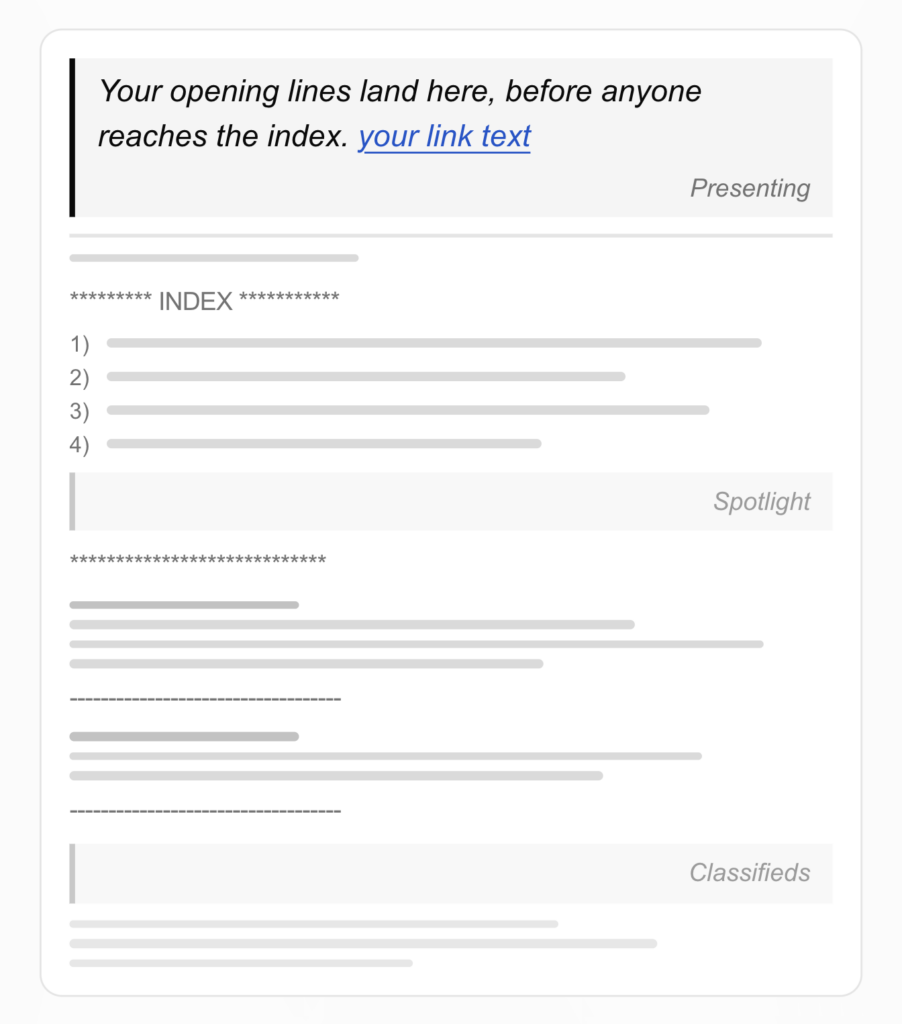
There are three placements: Presenting, Spotlight, and Classified. Each has its own position in the edition and its own character limits.
You can buy one placement or several across different editions and dates.
What are the HARO ad specs?
Every HARO ad is plain text. Each ad has body copy and link text, plus one destination URL that begins with https://. Images and HTML are not accepted.
| Placement | Ad copy | Link text | Where it appears | Label in the edition |
|---|---|---|---|---|
| Presenting | Up to 350 characters | Up to 30 characters | Top of the edition, above the journalist query index | Presenting |
| Spotlight | Up to 350 characters | Up to 30 characters | Below the query index, above the first journalist query | Spotlight |
| Classified | Up to 140 characters | Up to 24 characters | Closing Classifieds block after the last query. Up to three listings per edition | Classifieds |
What are the HARO advertising guidelines?
HARO reviews every advertisement before publication. Use this checklist before you submit.
Your ad should:
- Name the company and clearly describe the product or offer being promoted.
- Link to a page that is about the offer in the ad.
- Use a destination URL that begins with https://.
- Make claims about results or reach specific enough for a reader to verify.
- Mention a money-back guarantee only if it applies to the advertiser’s own product or service.
Your ad cannot:
- Promise a story or media coverage.
- Imply that payment purchases or guarantees editorial coverage.
- Describe a HARO ad placement as guaranteed press.
- Sell links.
- Name a publication in a way that makes a paid advertisement look like news or editorial content.
- Imply that HARO wrote, approved, endorses, or recommends the advertiser or its offer.
Destination URL requirements:
- The URL must begin with https://.
- The destination should be a page about the offer promoted in the ad.
- Paywalled, checkout, and signup pages are more likely to be returned for revision.
Good to know:
- Your receipt and review decision, plus any revision requests, go to the work email provided with the order.
- You do not need a HARO account to purchase an ad.
- Use a work email associated with the company in your ad. If the email address does not match the company being advertised, the order may receive extra scrutiny.
How much does it cost to advertise on HARO?
HARO advertising rates depend on the placement, edition, and weekday you choose. The table below shows Thursday base rates. Monday through Wednesday are priced above the Thursday rate and Friday is priced below it, so Friday is the lowest-priced day on the card. The booking calendar shows the actual price for every open date. The lowest-priced placement is a Friday Evening Classified at $105.
| Placement | Morning | Afternoon | Evening |
|---|---|---|---|
| Presenting | $795 | $625 | $525 |
| Spotlight | $395 | $315 | $265 |
| Classified | $195 | $155 | $125 |
A la carte orders receive automatic volume discounts: 10% for 4 or more placements, 15% for 8 or more, 22% for 16 or more, and 28% for 30 or more.
HARO also offers fixed-price bundles:
| Bundle | What it includes | Price |
|---|---|---|
| Try HARO | Four Classified placements, Afternoon edition | $450 |
| Spotlight Week | Five Spotlight placements, Morning edition | $1,595 |
| Presenting Week | Five Presenting placements, Morning edition | $3,195 |
| Classified Month | 20 Classified placements, any edition | $2,395 |
| Full Month Presence | Four Presenting, eight Spotlight, and 20 Classified placements | $6,450 |
Bundle discounts are already included in the listed prices and do not stack with volume discounts.
How to advertise on HARO
Step 1: Choose your placement and dates
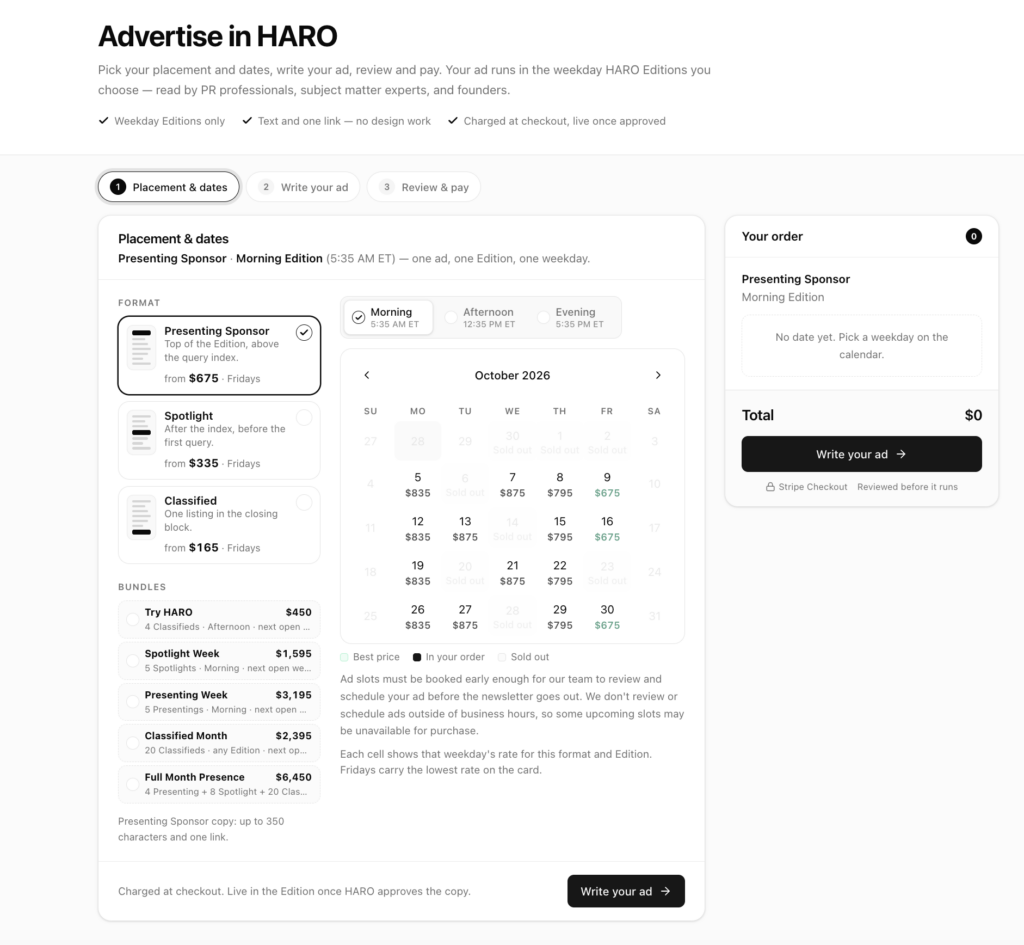
Go to helpareporter.com/advertise. Select the placement you want, then the edition and publication date. Ads run in weekday editions only.
You can buy a single placement or select several dates and editions in one order. The calendar shows the price for each open date up to 45 days ahead. Dates that are too close to send time or already sold are unavailable. You can also pick one of the bundles if you want to run several placement types.
Step 2: Write your ad
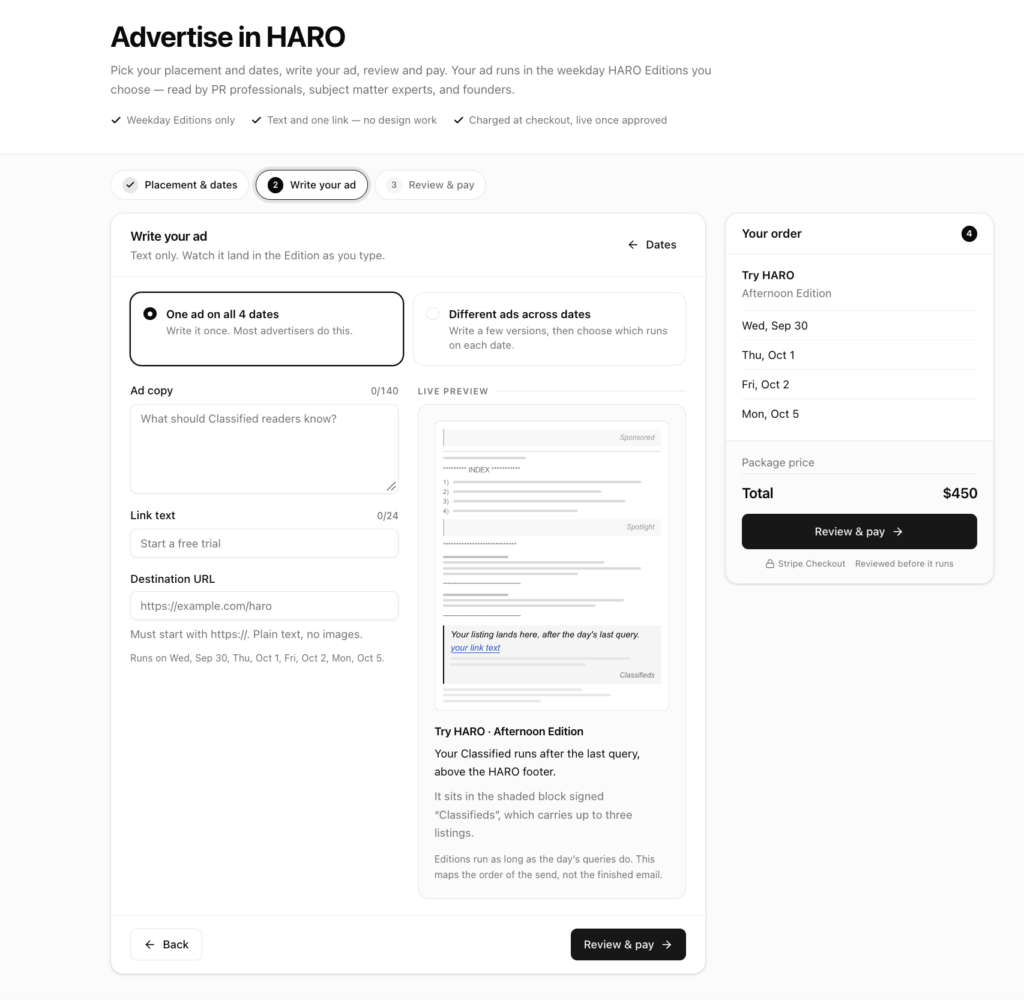
Enter your ad copy and link text, then add one destination URL. A live preview shows where the ad lands in the edition as you type. Check your copy against the specs and guidelines above.
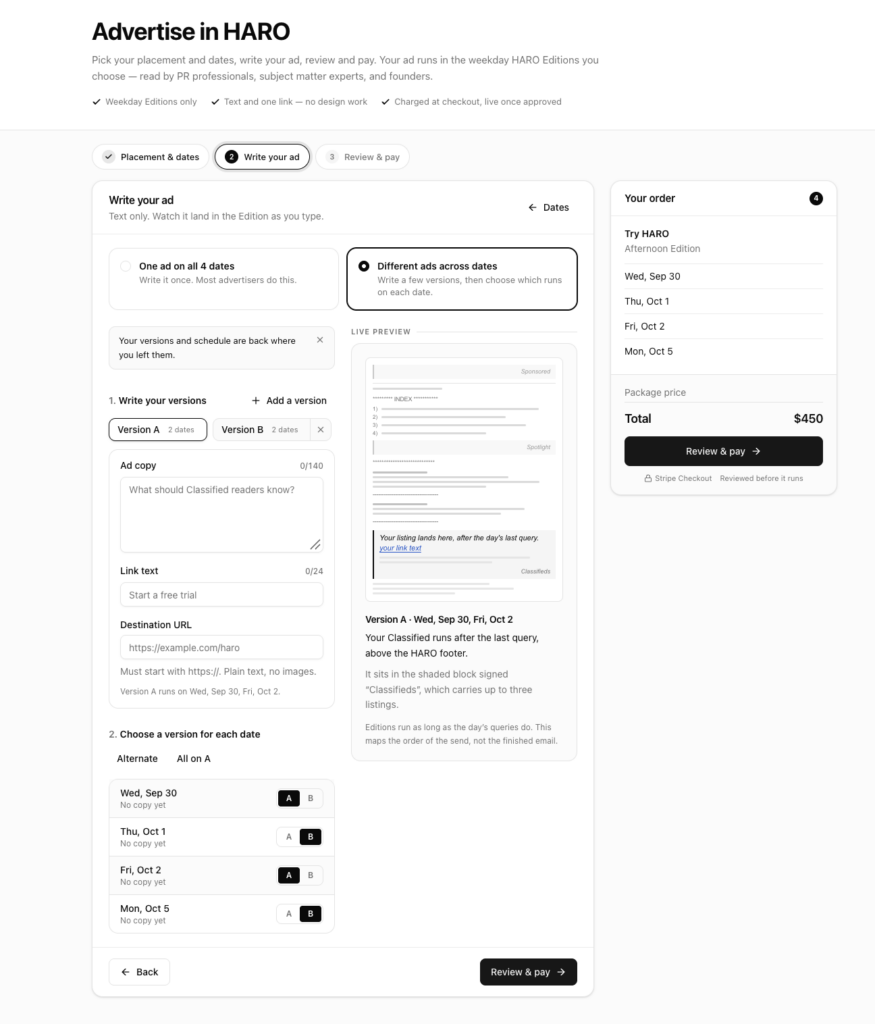
If your order includes more than one send, you can write several versions of the ad and choose which version runs on each date. You can use one version everywhere or alternate versions across dates. A version that is not assigned to a date is not saved.
Step 3: Review your order and pay
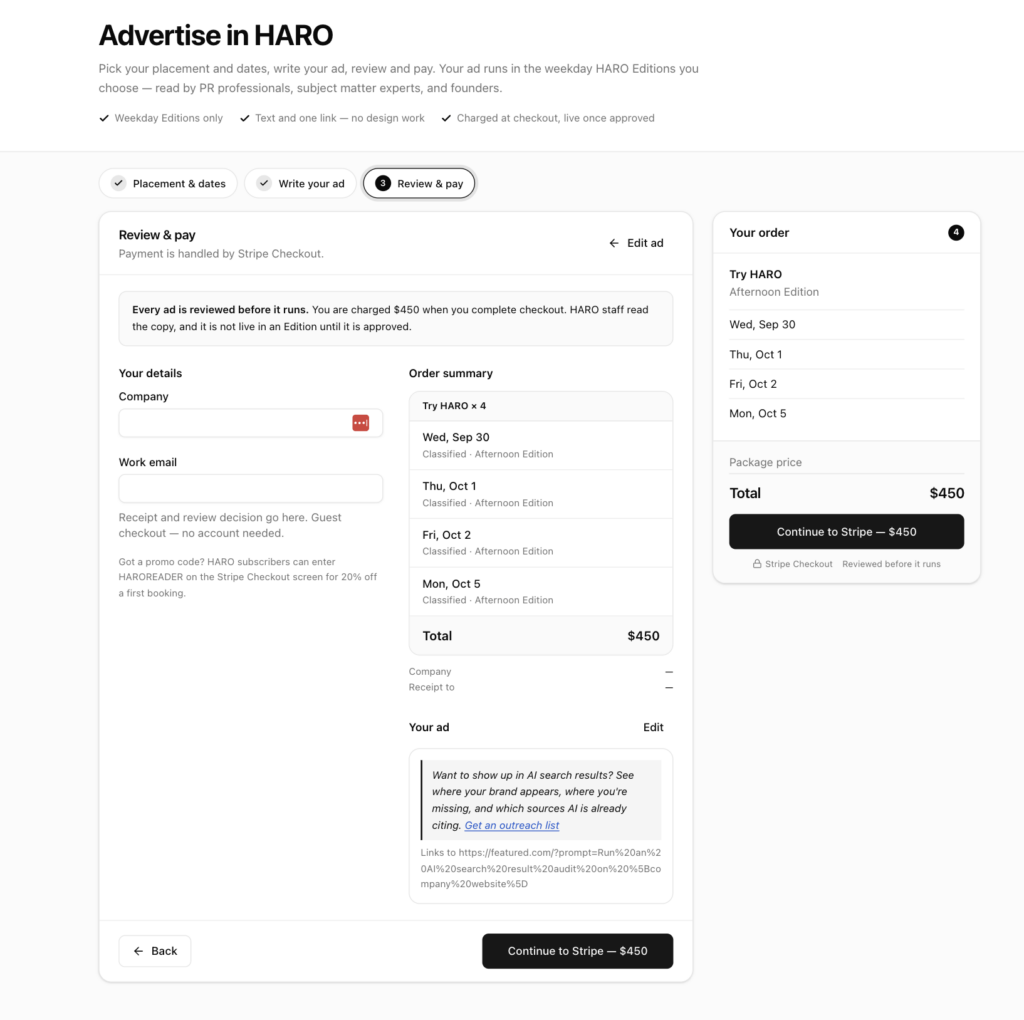
Review your placements, dates, editions, and ad copy, then complete checkout. Payment is handled by Stripe Checkout, and you do not need a HARO account.
First-time advertisers can enter the code HAROREADER on the Stripe Checkout screen for 20% off a first booking.
After payment, you receive an email confirming that your ad was purchased and submitted for review. Once your ad is approved and scheduled, a second email confirms the edition and date.
What happens after you submit a HARO ad?
HARO needs lead time between booking and publication to review and schedule ads. Ads are not reviewed or scheduled outside business hours, so some upcoming editions may be unavailable at checkout.
If your ad meets the guidelines, HARO approves it and schedules it for the selected edition and date.
If HARO requests changes, the work email on the order receives a message explaining what needs to change and the revision deadline. Advertisers can request up to two rounds of revisions.
The revision deadline is one full weekday before the first scheduled send, at the same Eastern time the edition goes out. Weekends do not count. An ad scheduled for a Monday edition, for example, must have its revision submitted by the same time on the previous Friday.
A reminder is sent about one day before the deadline if the update has not arrived. Use the link in the revision email to make changes. If an order contains several ad versions, update each version named in the email.
If the revision deadline passes, or HARO declines the advertisement, the order is cancelled and the charge is refunded. Refunds typically arrive within 5 to 10 business days.
HARO Advertising FAQ
Yes. HARO is free for journalists to post requests and free for sources to receive and answer them. HARO is supported by advertising rather than by subscription fees charged to PR professionals.
PR professionals, publicists, marketers, founders, and subject matter experts who want to be quoted in the press. HARO sent more than 100 million emails to subscribers in the past year.
Each ad can include one destination URL, which must begin with https://.
Yes. When an order includes several sends, you can write several ad versions and assign them to specific dates and placements. Several dates can share the same version.
No. Every placement runs to the full edition list.
No. You can purchase a HARO ad without creating or having a HARO account.
Yes. Every HARO advertisement is reviewed by HARO staff before publication.
The advertising calendar shows available editions up to 45 days ahead. Dates that are too close to send time or already sold are closed.
Ads need at least one business day before publication for review and scheduling. If HARO requests revisions, the advertiser receives a deadline by email, and the ad must be approved before that deadline to run as scheduled.
If HARO declines an advertisement, the order is cancelled and the charge is refunded. Refunds typically arrive within 5 to 10 business days.