
PR teams have traditionally used publication reputation, audience size and SEO authority to decide which outlets belong on a media list. Those signals still matter, but AI search introduces another question:
Which publications is AI already using to answer questions about your industry?
An analysis of 405 completed GEO audits conducted through Featured between June 2 and August 21, 2026, found 22,881 AI citations across 11,499 distinct domains, according to the Featured AI Citation Report, June–August 2026. The findings reveal a much broader and more fragmented source landscape than traditional media lists might suggest.
For PR teams, that creates an opportunity to use AI citation data as another signal when deciding where to focus outreach.
AI Search Draws From a Broad Range of Sources
Traditional SEO metrics can tell PR teams a lot about a publication’s conventional search authority, but they don’t fully describe the sources AI search uses to answer category questions.
Across the 22,881 citations in Featured’s GEO Audit dataset, 34.5% went to domains with a Domain Authority below 40.
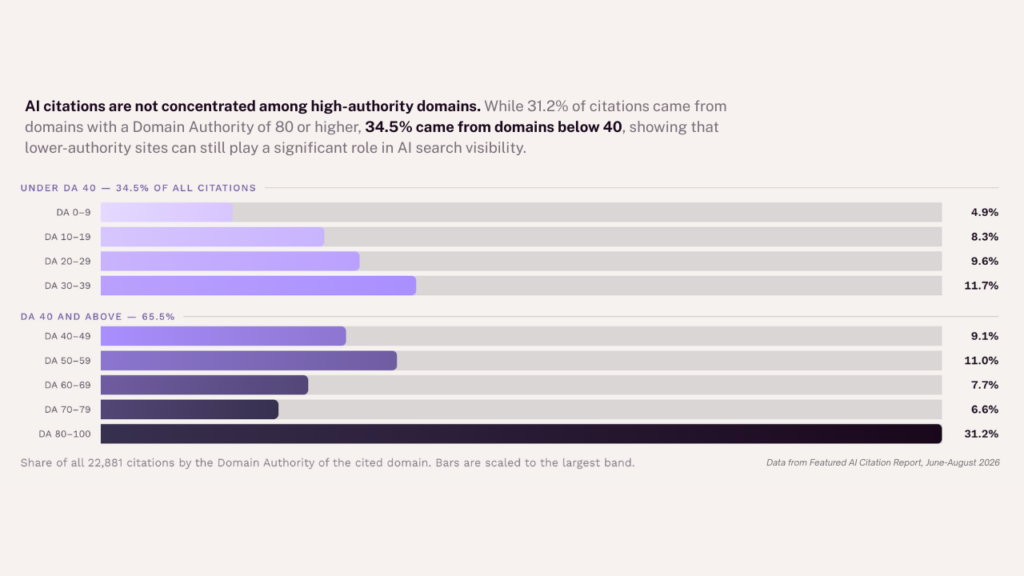
Looking at the websites themselves rather than citation volume, the pattern is even broader. 53.9% of the 11,499 distinct domains cited had a Domain Authority below 40, and the median cited domain had a Domain Authority of just 37.
At the same time, high-authority domains remain important. 31.2% of all citations went to domains with a Domain Authority of 80 or higher.
The takeaway isn’t that PR teams should stop pursuing high-authority publications. It’s that Domain Authority alone doesn’t tell you which sources AI search may use for a particular question.
A niche publication with modest SEO metrics could be cited repeatedly for questions in a specific category, while a much larger publication may not appear at all.
There May Not Be a Single AI Media List
The citation data also reveals how fragmented AI search can be.
The 22,881 citations were spread across 11,499 different domains. 76% of those domains were cited exactly once.
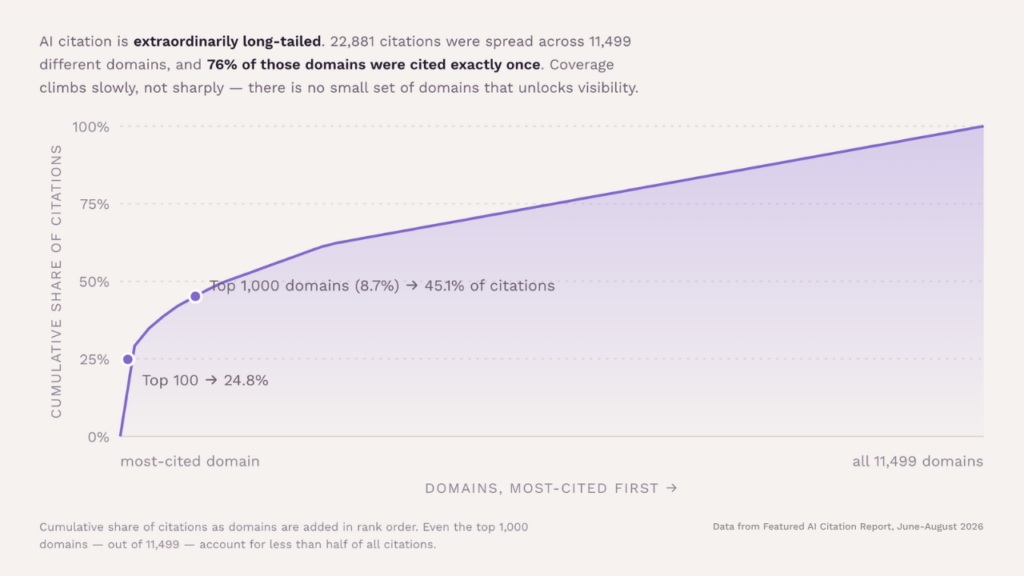
That makes it difficult to create a universal list of publications that every brand should pursue for AI visibility. The sources that matter can vary based on the questions being asked, the industry and the specific category.
For PR teams, that means the traditional approach of building a media list based primarily on publication size, reputation or SEO metrics may miss opportunities.
Instead, teams can start with the questions their customers are asking AI and work backward from the sources appearing in those answers.
Most Brands Are Still Invisible in AI Search
The audit data also shows why this matters.
Across 405 completed audits covering 378 brands in 344 industries, 78.5% of brands were not mentioned in any of the buying questions tested for their category. Across the 1,983 buying questions tested, an audited brand was mentioned in just 6.7% of questions.
Brands’ own websites were even less visible. 92.6% of brands never had their own website cited in an AI-generated answer about their category, and just 2.0% of the buying questions produced a citation to the brand’s own site.
The low mention rate was consistent across the four AI models tested. Brands were mentioned in 5.7% of questions on Perplexity, 4.5% on ChatGPT, 4.4% on Claude and 2.8% on Gemini.
For brands, the takeaway is clear: most are still largely absent from AI-generated answers about their categories, and their own websites rarely appear as sources.
AI Cites Editorial Coverage More Than Brand-Owned Content
The audit data also points to a potential gap between what brands publish themselves and what AI search uses to answer questions about them.
Of the 10,176 citations classified by source type, editorial coverage accounted for 64.5%, while brand-owned content accounted for just 1.7%.
Competitor sources accounted for 22.6% of classified sources.
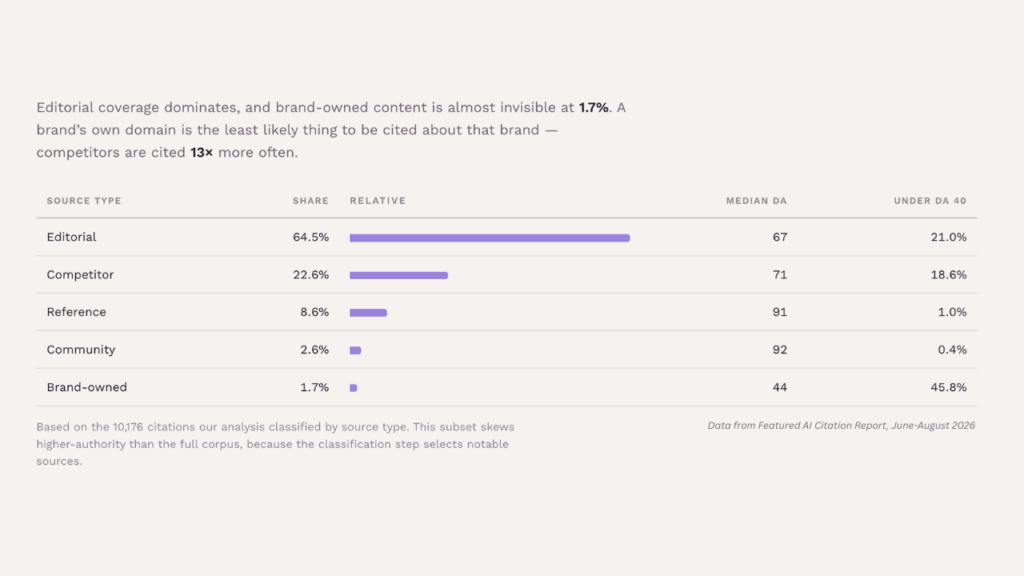
That means competitor content appeared in the classified citation set more than 13 times as often as brand-owned content.
The finding doesn’t mean brands should stop investing in their own content. Instead, it suggests that earning third-party coverage may be an important part of how brands expand their presence in the sources AI search draws from.
For PR teams, that creates a practical opportunity: identify the publications already appearing in AI answers, then determine which of those outlets are realistic targets for coverage. The publications surfaced by the audit can then be pursued through journalist requests on HARO and Featured.
Find the Publications AI Is Already Citing
The challenge is figuring out which sources matter for a particular brand.
PR teams can start by identifying the questions customers are likely to ask AI search engines. From there, they can examine which brands and sources appear in the answers and look for publications that repeatedly influence relevant prompts.
This is where AI visibility research can become a practical PR tool.
Featured’s GEO Audit shows teams where their brand appears in AI search, where competitors appear instead, and which publications, websites and articles AI cites. It then ranks the publications to pitch based on citation frequency, giving teams a prioritized list of media targets. From the audit, users can draft a pitch with the Draft Pitch button or find active media requests from that publication, all within Featured.
Instead of starting with a traditional media list and guessing which outlets might influence AI visibility, PR teams can use the sources AI is already citing as a data point for deciding where to focus outreach.
Featured’s GEO Audit can also surface a different type of visibility gap: an AI search engine may cite a brand’s own website without actually mentioning the brand in its answer. In that situation, the opportunity may be to strengthen or promote existing content rather than pursue entirely new coverage.
The result is a more targeted approach to AI visibility: identify where a brand is missing, understand which sources are influencing the answers, and prioritize the publications that may be worth pursuing.
AI Visibility Gives PR Teams a New Media Signal
The 405 GEO audits don’t suggest that traditional authority is irrelevant. High-authority websites remain a major part of the AI citation landscape. But they do show that the landscape is broader than a conventional SEO-based media list might suggest.
More than half of the distinct domains cited had a Domain Authority below 40. Three-quarters of cited domains appeared only once. And nearly four out of five brands audited were not mentioned in a single buying question in their category.
For PR teams, that creates a new signal for media targeting. The question isn’t only:
“How authoritative is this publication?”
It’s also:
“Is AI already using this publication to answer questions about my industry?”
That signal can help PR teams identify relevant outlets they might otherwise overlook and prioritize outreach around the sources shaping the AI answers their customers see.