
How are PR professionals actually using AI in their daily work?
To explore how AI is being used in PR, we issued a HARO query seeking firsthand perspectives from practitioners across the industry. More than 64 professionals responded, ranging from solo consultants to established, award-winning agencies, many with careers spanning two to three decades.
What was the main takeaway? AI is delivering PR the most value as an accelerator of thinking, research, and execution.
The following sections offer qualitative glimpses into how AI is being applied in PR:
- AI as a Thinking Partner
- Research and Data Aggregation
- List Building for Media Contacts
- AI-Powered Influencer Discovery
- Tailoring Pitch Angles for Different Geographic Markets
- Persona-Based Prompts for Pitch Refinement
- Real-Time News Monitoring and Reactive Pitching
- AI Visibility and Generative Engine Optimization (GEO)
- Productivity and Workflow Management
- Custom GPT “PR Command Center”
- Meeting Documentation and Notetaking
- Content Review and Quality Assurance
- Administrative Tasks and Billing
- Prototyping and Mockups
- The Human Element Remains Essential
AI as a Thinking Partner
At O’Connell & Goldberg, a public relations firm founded in 1993, AI has become embedded in the agency’s creative and strategic process.
“I like to consider AI my thinking partner,” said Barbara Goldberg, CEO and founding partner of the firm. “What used to happen in the old days was gathering everyone for a brainstorming session. I still love a good brainstorming session, but now I don’t have to rely solely on staff to generate ideas. I can prompt AI, reason with it, and treat it like a strategic collaborator.”
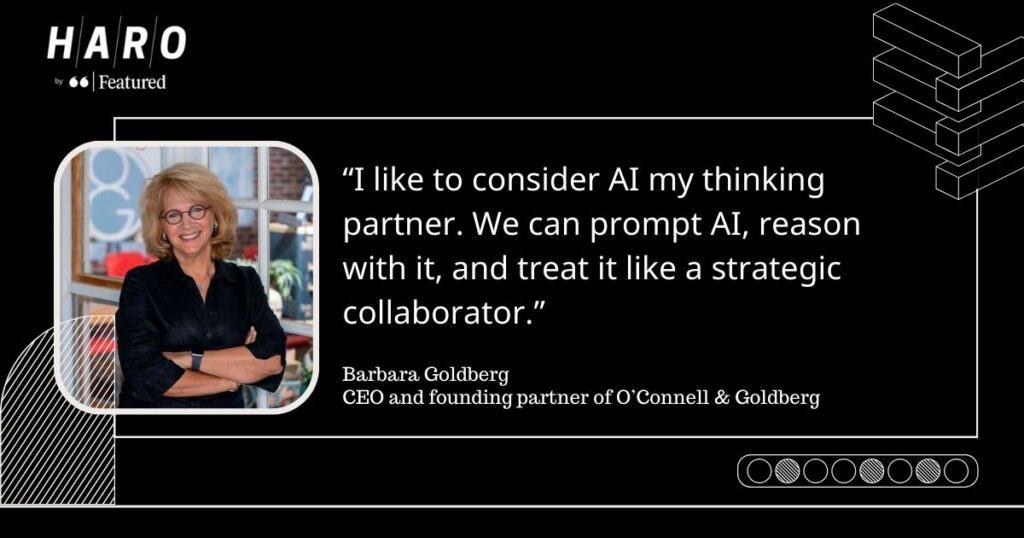
Goldberg describes the technology as a source of feedback and alternative perspectives rather than a replacement for human expertise.
“It serves as a creative engine for us, giving ideas and strategies we may not have considered,” she explained. “It doesn’t replace our staff. It’s an extension of our staff, and it makes us better, smarter, and faster.”
She emphasized that effective use requires active engagement.
“You have to push it, challenge it, and not settle for the first response,” Goldberg said. “The value comes from the back-and-forth, where you keep refining the thinking.”
Research and Data Aggregation
For Jennifer Schenberg, AI has become deeply integrated into how her agency approaches research, particularly when evaluating new prospects or supporting client expansion.
“What AI is wonderful at is bringing analyst research, quotes, statistics, and public data together very quickly,” said Schenberg, chief talker at PenVine, a technology-focused public relations and marketing agency. “It really provides fresh perspectives, which is what we’re looking for. When clients are expanding into new markets or offering new solutions, AI helps us understand competitive positioning, market history, opportunity, and even market sizing data.”
PenVine’s team relies on multiple AI engines, including Perplexity, Gemini, Claude, and ChatGPT, to accelerate discovery. Schenberg emphasized, however, that speed does not eliminate the need for careful validation.
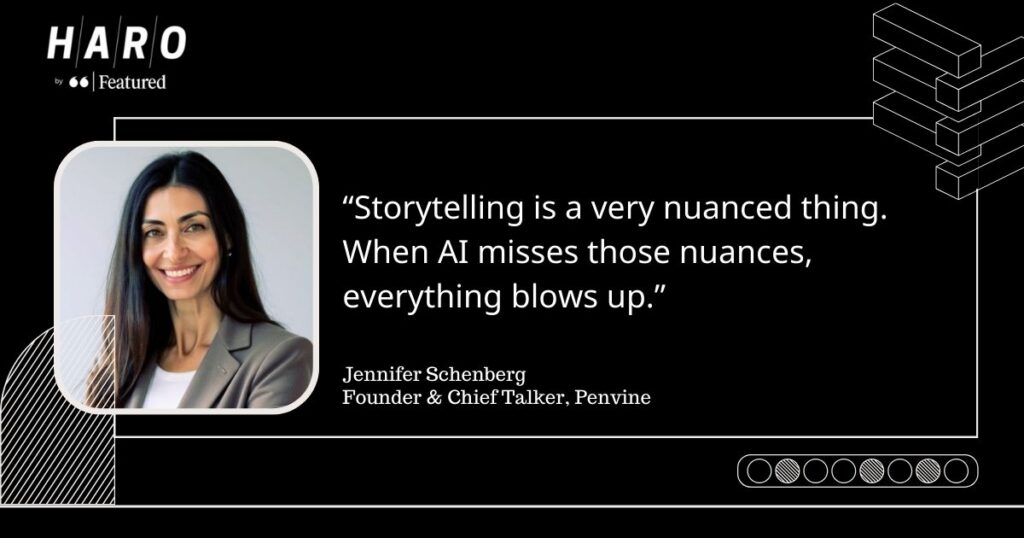
“Storytelling is a very nuanced thing, and when AI misses those nuances, everything blows up,” she said. “Nuances can determine the difference between facts and fiction, and ultimately shape whether we meet the goals clients care about.”
For PR teams, AI’s value in research lies in accelerating information gathering, not replacing critical evaluation. Human judgment remains essential for interpreting context, verifying accuracy, and preserving the nuances that shape effective communications.
List Building for Media Contacts
When faced with doing outreach for a very niche client, Olivia Walker used a paid version of ChatGPT to create a targeted media list. She then hired a specialist with access to contact databases to complete the list for around $150, which she found to be significantly cheaper compared to traditional PR software providers.
“I must have been the very last person to adopt AI,” said Walker, founder of Evolved PR, a San Diego-based strategic public relations and crisis communications firm. “But what I have found is that AI is very good at creating media lists. I can get journalist names, what they cover, their angles, and publication names – but it doesn’t give me access to personal email information. That’s when you need to get a little creative.”
Walker’s experience highlights how AI is reshaping one of PR’s most fundamental workflows, as well as where dollars are flowing within the industry. By separating media discovery with data enrichment, practitioners are reducing costs while preserving the precision required for effective outreach.
AI-Powered Influencer Discovery
Langley Allbritton is a communications consultant who spent the last decade working across roles at NetApp and Intel, working in both external and internal communications. Recently, she wanted a way to identify influencers in her space. So, she went to LinkedIn, struggled with the search capabilities, and got frustrated with the inability to quickly build an influencer list.
“I ended up building an agent that scanned the internet for topics I was interested in, and ended up with a complete list of influencers,” said Albritton, now the president of AI Communications Consulting, a firm that supports leaders and communicators to accelerate AI adoption. “The system cross-checks LinkedIn profiles against other public online information, consolidates the data, creates overviews, categorizes results, and provides direct links to LinkedIn profiles.”
This AI-powered influencer discovery allows for more efficient identification of relevant contacts and enables better understanding of their interests before outreach, helping ensure an authentic connection.
Tailoring Pitch Angles for Different Geographic Markets
Pitch customization for regional media outlets often proves more effective than a one-size-fits-all approach. That’s why Jodie Booras uses AI to adapt story angles for clients, including a senior in-home care company seeking to connect with audiences across multiple markets.
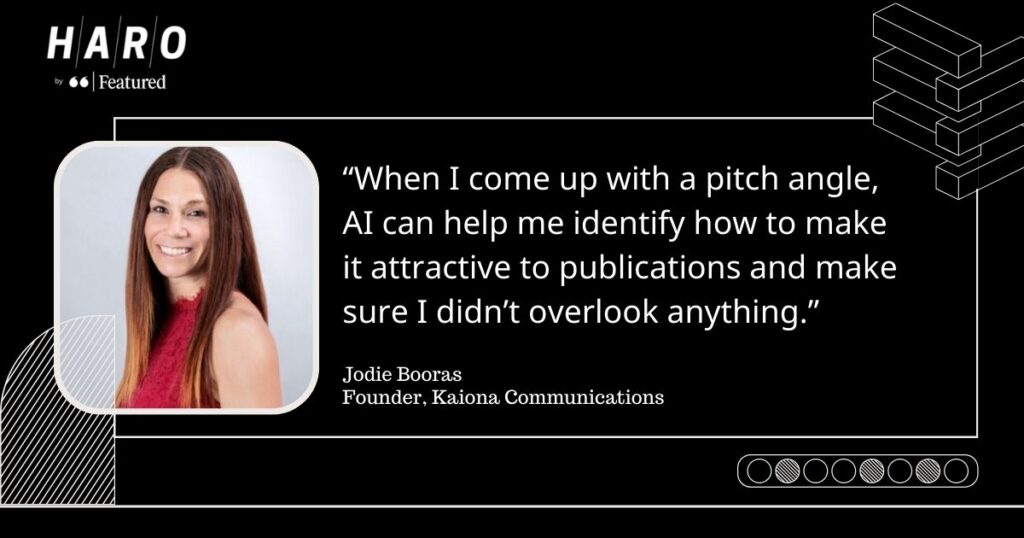
“Even though my client is in Boca Raton, they want to reach their target audience in Boston, Detroit, Canada, and New York,” said Booras, who was named Freelancer of the Year by the Public Relations Society of America (PRSA) through her work at Kaiona Communications. “When I come up with a pitch angle, AI can help me identify how to make it attractive to publications in other locations and make sure I didn’t overlook anything.”
Personalized outreach is often the difference between being ignored and earning coverage. In this context, AI helps communicators craft pitches that feel both timely and tailored to the expectations of specific markets.
Persona-Based Prompts for Pitch Refinement
Jennifer Stephens Acree and her team have developed a distinctive way of using AI to pressure-test their work before it reaches clients or journalists.
“One of the ways we use AI is through persona-based prompts,” said Acree, founder and CEO of JSA+Partners, a Los Angeles-based communications agency. “We created a persona called Farrah, modeled as a tough journalist. We’ll write a pitch, put it into Farrah, and see what Farrah thinks.”
Rather than generating content, the persona functions as a critic.
“Farrah gives very honest feedback on whether or not a pitch is going to land,” Acree explained. “It’s a way to really hone in on what’s going to resonate, especially in a tough media environment where you’re constantly asking how to make people care.”
The team applies a similar approach internally, including personas modeled after agency leadership.
“For junior team members who want another layer of feedback before routing something internally, AI personas are a really nice way to make that more efficient,” she said. “It helps refine the work without adding additional review cycles.”
Real-Time News Monitoring and Reactive Pitching
Alex Fiske and his team use AI to monitor breaking news stories in real-time for clients.
“We’ll prompt AI with something like, ‘Give me the top 10 breaking news stories around the world that involve car insurance,’” said Fiske, the PR lead at Aira, a UK-based digital marketing agency. This allows the team to spot opportunities within an hour and respond quickly.
“In one case, we managed to submit an expert comment on an article that was live for only 23 minutes,” shared Fiske. “Then we used that same story and expert to go to other media. We got 13 pieces of coverage off the back of it, thanks to AI allowing us to spot a timely opportunity.”
Real-time news monitoring and reactive pitching are core to PR workflows, where AI can function as an always-on system that scans large volumes of unstructured information. This allows PR teams to identify timely opportunities that can translate into meaningful coverage and generate follow-on results.
AI Visibility and Generative Engine Optimization (GEO)
Julie Wright began closely examining AI’s impact after noticing a steady decline in organic search performance, both for her site and her clients. As Wright investigated the shift, she concluded that AI-driven interfaces were fundamentally altering how audiences access information.
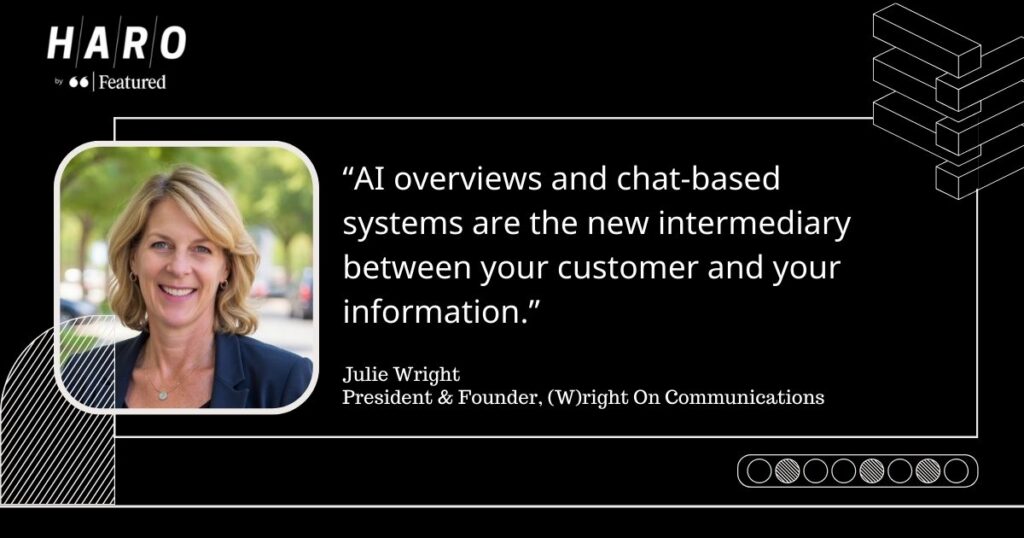
“I realized that AI overviews and chat-based systems are the new intermediary between your customer and your information,” said Wright, president and founder of (W)right Communications, an integrated communications and public relations agency headquartered in San Diego, California. “If users are no longer clicking through to websites because they’re getting the answers they need directly from AI, then the real question then becomes how a brand shows up in those AI-generated responses.”
Wright found that earned media plays an increasingly important role in this environment, citing the credibility signals associated with authoritative coverage.
“It became clear that high-quality media placements carry weight because of the authority and trust they convey,” she said. “That insight pushed us to think about visibility in a way that blends public relations, search strategy, and message consistency.”
Her experience reflects a broader industry realization that AI visibility is emerging as a new communications priority. Rather than replacing traditional PR objectives, generative engine optimization reframes them around discoverability, authority, and structured brand presence.
Productivity and Workflow Management
Don Martelli’s Boston-based basement setup features two 50-inch TVs, an iPad, a gaming setup, and a digital calendar on the wall – essentially configured like a war room bunker with screens surrounding him. The screens display an orchestration of an extensive AI-powered tech stack – including Motion, Evernote, ChatGPT, Claude, Perplexity, Gemini, Gamma, Notion, Granola, Otter AI, and Prowly – to allow Don to effectively and efficiently function as a one-person PR firm.
How does Don leverage this stack to operate independently and deliver on media list development, project management, billing, invoicing, reviewing data, and other critical tasks?
“I just built out a bunch of account coordinators that are LLMs,” said Martelli, a former Boston Globe journalist and CEO at PR Bunker, a strategic communications consultancy. “Each tool functions as a specialized assistant handling a different aspect of my workflow. The format allows me to be more efficient with the work, and focus on making my clients successful.”
Martelli emphasizes the system allows him to “work on the business” instead of getting buried in execution – a shift that illustrates how AI is reshaping how communications professionals structure their work and scale their impact.
Custom GPT “PR Command Center”
Blair Huddy did not come from a technical background when she decided to build a custom GPT. Encouraged by how simple the process sounded, she began by asking herself what would be valuable for the work her integrated marketing communications agency was doing.
“That’s really how it started,” said Huddy, founder of Hudson Davis Communications. “I designed a GPT as a command center so I wasn’t constantly repeating the same thought processes or tracking the same details for every client. Now I can simply activate my command center for each client and work from there.”
Huddy’s command center serves as a comprehensive system covering all the core functions: providing pitch ideas, finding ideal journalists, keeping a running tab of events and awards, conducting industry and competitive research, supplying quote ideas for subject matter experts, and running crisis analysis and scenarios. Plus, the GPT flags execution gaps before they happen.
By centralizing knowledge and workflows, AI-enabled command centers allow for greater consistency across clients and campaigns while serving as a highly trained thinking partner.
Meeting Documentation and Notetaking
Amy Power founded The Power Group, a PR agency based in Dallas, more than 26 years ago. The firm currently has about 10 employees, serves clients nationwide, and uses the AI notetaker Fireflies for meeting documentation and client call recaps.
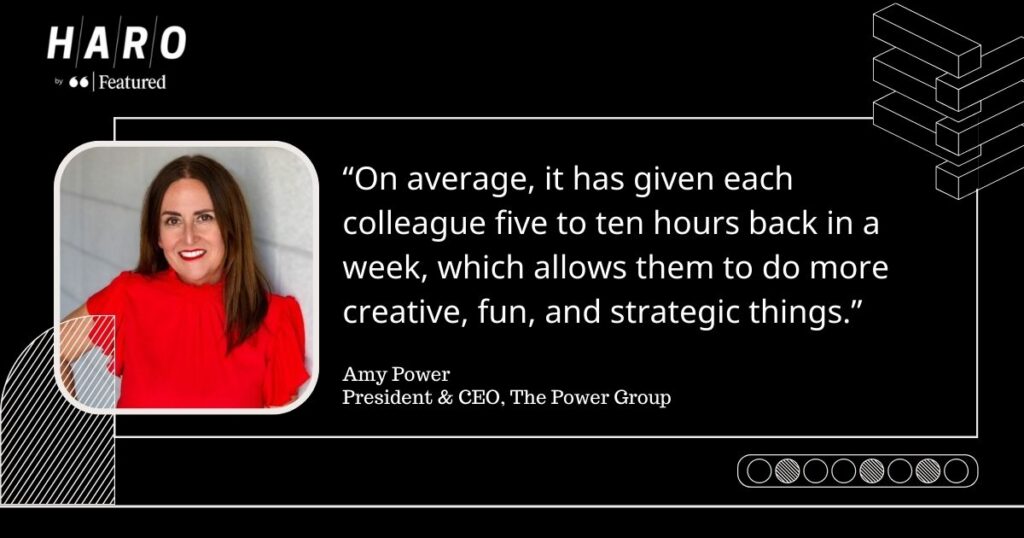
“Fireflies has been especially helpful for recapping our meetings,” said Power, who noted the tool provides bullet points of calls and serves as a great reminder of what a client said. “On average, it has given each colleague maybe five to ten hours back in a week, which allows them to do more creative, fun, and strategic things.”
The notetaker also integrates with the firm’s CRM, allowing an automatic import of notes from new business conversations directly into a defined workflow. For PR teams, AI notetakers are key to reducing manual work while keeping everyone aligned.
Content Review and Quality Assurance
After more than two decades in public relations, Nicole Blake-Baxter has seen how much time agencies can lose to internal review cycles.
“Something as simple as a press release would usually take several rounds of reviews internally before it even gets to the client,” said Blake-Baxter, who founded The Blake Agency, a boutique PR firm in Atlanta serving nonprofit, tech, and travel clients.
For her team, AI has helped compress that process while also improving accuracy.
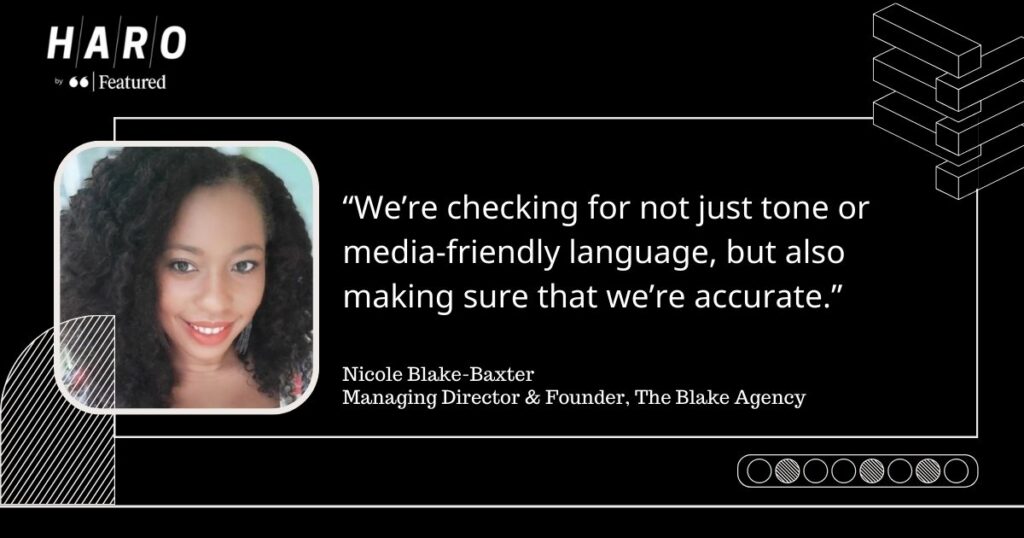
“We’re really checking for not just tone or media-friendly language, but also making sure that we’re accurate,” she explained. “I can take a briefing document a client shared with us and compare it to a page on their website. That makes it much easier to confirm there aren’t any gaps between the two sources.”
By reducing internal review time, Blake-Baxter said AI allows the agency to move content forward more efficiently while maintaining quality control.
Administrative Tasks and Billing
Julie Phillippi-Whitney, a PR professional with 35 years of experience, recently received a request from a client that was unlike any she’d received before.
“Julie, can you please send me links or PDFs for every story that’s run since 2011?”
“There were 383 of them,” said Phillippi-Whitney, a children’s author and owner of Phillippi-Whitney Communications, a PR firm based in Cincinnati, Ohio. “It was going to take me forever to go through every invoice since 2011. So I uploaded all invoices into Claude and asked for an Excel spreadsheet that listed all the stories in chronological order with any associated links. I’d work in batches of 20 invoices at a time, and boop – they’re on a spreadsheet. It saved me hours.”
For PR professionals faced with time-consuming administrative work, Phillippi-Whitney’s experience reinforces how AI can turn even the most tedious archival requests into manageable, time-efficient tasks.
Prototyping and Mockups
Diane Gayeski is a professor of strategic communications at Ithaca College who has been teaching students since 1979. In her introductory PR class, she requires her students to use AI for creating prototypes of media materials, particularly when they lack technical production skills.
“Using AI to mock up a video or presentation gives the students and the client an idea of what they’re thinking,” said Gayeski, who is also the owner of the consulting firm, Gayeski Analytics. “It gets you a lot closer to a finished product, and you get better feedback from the client when they see something that’s more specific.”
Whatever the media material, the result for PR practitioners of all skill levels is faster iteration, clearer alignment, and more actionable client feedback.
The Human Element Remains Essential
While AI is reshaping many PR workflows, Adam Handelsman argues that the profession’s defining skill remains deeply human.
“I started PR before email,” said Handelsman, founder of SpecOps Communications, a media relations firm in Austin, Texas. “It taught me how to get on the phone and talk. You can’t build a real relationship through email or text. That may get you in the door, but relationships are built through actual conversations.”
For Handelsman, relationship building is not just part of the job but the core differentiator in media relations.
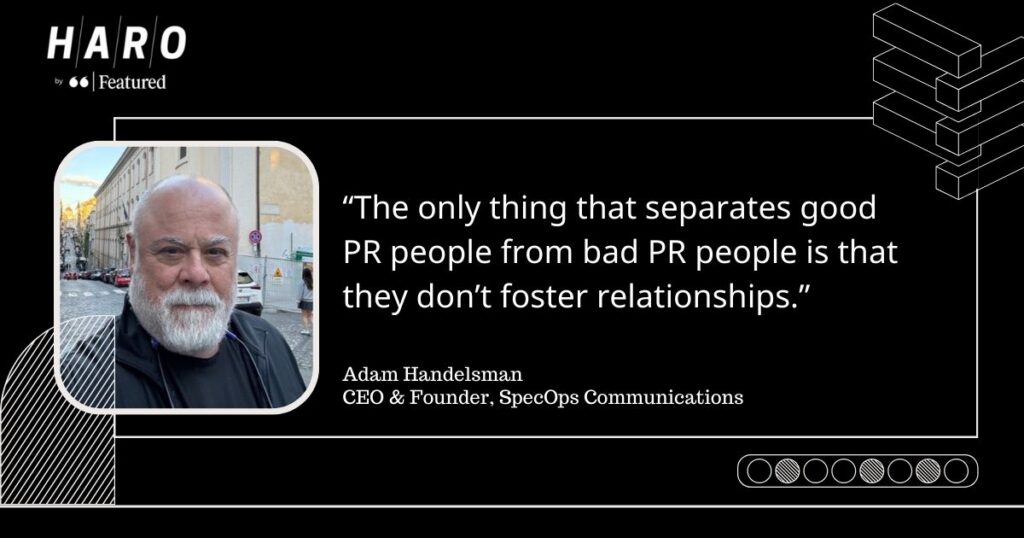
“The only thing that separates good PR people from bad PR people is that they don’t foster relationships,” he said. “If I work with a reporter once, I’m going to go back to that person again and again. Over time, they know I’m not going to waste their time, and that trust is everything.”
When asked whether AI could play a meaningful role in that process, Handelsman was skeptical.
“I don’t think it’s personal enough,” he said, emphasizing that credibility and rapport are earned through direct human interaction rather than automation.
Despite the growing reliance on AI tools, Handelsman views technology primarily as an enhancement rather than a substitute. The mechanics of PR may evolve, but its foundation remains rooted in trust, judgment, and relationships.
AI Is Changing How PR Works, Not What PR Is
AI is reshaping how public relations work gets done, but not why it matters.
The practitioners featured here are not using AI to replace judgment, creativity, or relationships. Instead, they are deploying it to accelerate thinking, compress research cycles, reduce operational drag, and create more space for strategic and human-centered work.
The most effective uses of AI appear where it functions as a collaborator rather than a shortcut. Whether acting as a thinking partner, a research accelerator, a quality-control layer, or an always-on monitoring system, AI is helping PR professionals operate with greater speed, consistency, and confidence. At the same time, these examples make clear that nuance, credibility, storytelling, and relationship building remain resistant to automation.
As AI continues to evolve, the competitive advantage in PR will come integrating tools thoughtfully into existing expertise. The mechanics of public relations may change, but its foundation remains the same: trust, relevance, and human connection.