

Devon Blaine has been doing PR for 51 years. In that time, change has always been a constant. Changes in how and where people want to be featured. Changes in technology and communications.
The thing that hasn’t changed? “PR has always been about delivering a timely and honest message in an interesting way,” said Blaine.
This article explores what PR is in 2026. It’s no longer one thing. It’s many things, all still centered on Blaine’s definition of PR, but with different spokes that turn the wheel.
To capture what PR actually is, we interviewed PR practitioners about what they do for the clients they represent and the brands they work for.
In 2026, public relations is the discipline of earning trust and credibility for a brand everywhere its story gets told – in the press, on platforms, in person, and inside AI answer engines. The job now spans 38+ distinct practices, from op-eds and newsjacking to prompt research and answer-summary optimization, according to the PR practitioners interviewed for this article.
This is PR in 2026.
- I. The expanded mandate
- II. The reshaped press landscape
- III. Platform-native PR
- IV. Riding the moment
- V. The creator channel
- VI. Winning the AI answer
- VII. Proving the work
- VIII. The human layer
- Frequently asked questions
- What isn’t PR in 2026?
I. The expanded mandate
The roles and responsibilities of PR have expanded to shaping C-suite strategy, editing what publishers can’t, communicating to employees, and defining entire categories.
PR is storytelling + distribution
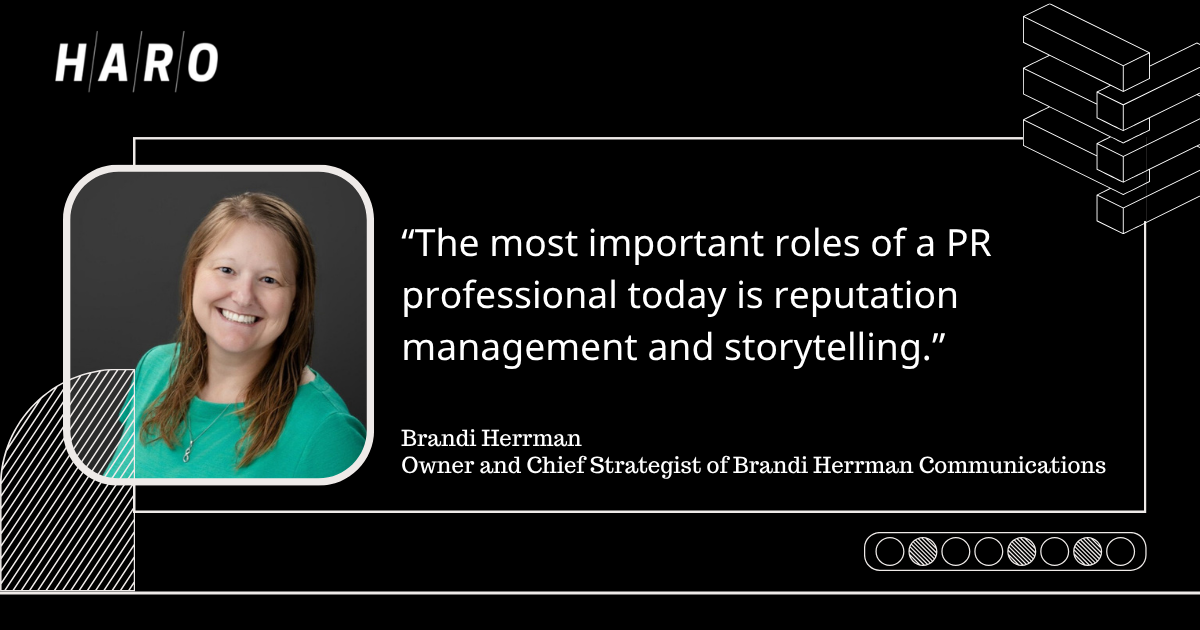
PR is storytelling, with professionals like Brandi Herrman, owner and chief strategist of Brandi Herrman Communications, operating as a producer and director.
“People think they know what the headline for their story should be, but in my experience, they never know the headline,” said Herrman. “I ask that clients trust me that I know what the headline is. Sometimes they believe you, sometimes they don’t. I’ve never gotten anyone to believe me until I show them.”
Beyond story identification, PR professionals find themselves telling and distributing the story. According to Herrman, the story is usually told on an owned platform like a website. Then, the story is stripped down to be posted on various social media channels with an optimized format — whether that’s vertical or horizontal shots, a reel, or carousel.
Why is the story important? For reputation management.
“Each story is a nickel in the piggy bank,” said Herrman. “For when a crisis comms scenario hits and you need to break the bank and get yourself out of it.”
PR is the editor, x3
David D’Arcangelo, CEO of Massachusetts-based Arc Angel Communications, remembers when newsrooms operated with a full staff and multiple different departments.
“The model I learned in college was that you have a publisher who wants a story. The story goes to an editor, then to another editor, and then to the reporter, who was double-checking everything,” said D’Arcangelo. “Now, that model has just been decimated.”
Publishers are keeping pace with content production by relying on PR to be the strategist, writer, and editor. Specifically, D’Arcangelo is finding himself doing more editing for tone and voice, fact-checking, and making sure the story fits with the publication’s strategy.
In other words, PR is filling the gaps in publications.
Being in the room
In various positions that Laura Krueger has held, communications has typically been an afterthought in C-suite planning discussions. The door opens to PR after the crisis happens, instead of comms pros being in the room from the beginning.
“The whole mindset is shifting, especially with how quickly things move in today’s day and age,” said Krueger, the director of marketing, communications, and public relations at Community Economic Development Fund (CEDF). “When PR is in the room, they can give counsel on how to avoid a reputational nightmare. There’s so many layers to so many different issues in a large national organization, and communications can’t be brought in after the fact.”
Several PR professionals, including Krueger, shared that they are more involved in C-suite and board-level conversations. Whether that’s to weigh in on AI visibility initiatives or to get in front of a narrative, one thing is clear: PR is earning a seat at the table.
Internal communications
In 2020, the workplace changed. Many employees went fully remote. In 2026, while the return to the workplace has taken hold, the reality is that more employees work remotely today than they did seven years ago.
Internal communications to employees mattered in 2019, and it matters more today in 2026. According to Mark Grossman, a solo PR practitioner and an adjunct professor of communications at Nassau Community College and Suffolk County Community College on Long Island, internal communications is the job PR professionals are taking on.
“A lot of organizations want external communications because they want to be in the press,” said Grossman. “But internal communications reaches a base made up of people who are going to be your deputies talking about your brand, your policies, positions, and the mission of the organization.”
The call to action is to value both internal and external communications. Apply the playbook of pitching journalists to communicating with employees. Catch their attention as you would with a press release. Communicate as needed to build and develop relationships. And view employees and stakeholders as some of your most valuable messengers, because those are the people who care the most about the words a PR professional drafts.
Category creation
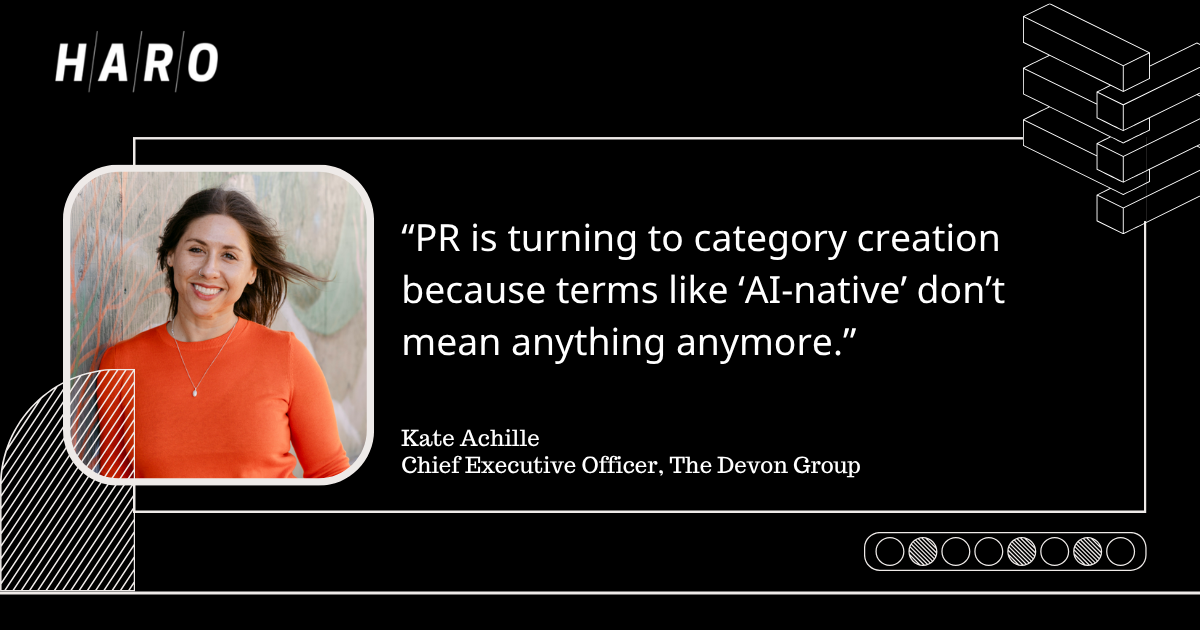
The Devon Group has been the agency of record for the HR Tech Conference since its inception 29 years ago. In that time, the categories of companies in the expo hall have changed. A few years ago, Kate Achille, the firm’s CEO, noticed the People Analytics category ballooning as well-funded Series A, B, and C companies competed for prospective client attention. Then, over the last few years, she’s witnessed the People Analytics category get segmented into smaller categories, ranging from Workplace Intelligence to People Intelligence.
According to Achille, the demand for category creation from clients has had a resurgence over the last year due to the noise in the market from all AI, all the time.
“Categorization is tricky right now, because AI has just flattened everything and is not distinguishing anything,” said Achille. “The challenge is standing out just enough to get press and attention, while also not alienating your buyer at the same time with the creation of a new category.”
PR is meant to support the story a company tells. Category creation is opening the door to differentiate on narrative, while remaining true to a company’s core.
II. The reshaped press landscape
Earned coverage is scattered across a longer tail of outlets. The entry points includes a mix of op-eds submissions, independent Substack publications, and source-request platforms like HARO.
Long-form content is cool again
Posting carousels made in Canva was fun for a minute. But after years of short-form, surface-level social media content, Kathryn Gisi, PR and communications manager at Covalent Logic, believes the pendulum is swinging back toward depth.
“Context is cool again,” shared Gisi, who cites long-form content like 60-minute YouTube videos and multi-shot Apple Music interviews as examples of the resurgence. “Collectively, we’re seeing consumers seek out content that requires our attention span and context.”
Reddit, which is traditionally thought of as short form, is another example of longer, text-based content. Starting a thread or an AMA (with Reddit moderator collaboration and approval) can allow consumers to go in-depth on a topic that could not be effectively conveyed through something like an image shared on social media.
Op-eds and contributed content
Dustin Siggins says that while the number of publications that accept op-eds and contributed content has shrunk, op-eds are still a very useful tactic in the PR toolkit because of third-party validity. And, he says, because PR agencies have shifted toward modern PR with Substacks, AEO (answer engine optimization), and influencers, the number of opportunities is significant despite the closures of many media outlets.
“You don’t want to be the horseshoe maker in the era of the car, but you do want to be the horseshoe maker at the Kentucky Derby,” said Siggins, founder of Proven Media Solutions. “Many agencies are focused on services that are op-ed tangential, while we’re very proud of op-eds.”
Siggins said one of his company’s best uses of op-eds is to find an outside author on top of an executive or founder telling the story. How it works: Proven Media Solutions finds people in its network with a story to share, gets the story out of the source, writes the op-ed using the interview as the baseline, and gets the source’s approval on the story. Then, the op-ed is pitched to local outlets that accept contributed content.
The firm’s op-ed work has landed placements in USA Today, The Tennessean, and others. For Siggins, the success, and overall trends in the local media landscape, indicate that third-party voices will become more influential in the years to come.
Independent publications + Substacks
Not long ago, getting a feature article on TechCrunch resulted in instant success because the news was seen and talked about by everyone.
Now, according to Ayelet Noff, founder and CEO of the PR firm SlicedBrand, PR is operating on a different model. It’s no longer the big splash on the big publication. It’s about being on long-tail publications that are targeted toward a niche audience.
“There are so many distribution channels and independent publications,” said Noff, who cited industry layoffs as one of the reasons driving the shift behind a fragmented media landscape. “Lots of journalists have created their own newsletters and Substacks. Each one of these channels has less traffic, but is more targeted.”
If there are more publications with smaller audiences, PR in 2026 means consistently appearing across long-tail publications. To identify the independent publications, Noff recommends developing relationships with journalists (especially when they’re just starting out) by following their moves on LinkedIn, X, and layoff news; seeing what gets cited in LLMs (a great way to discover publications); and using journalist databases as a backstop to fill in any coverage gaps.
Thought leadership in industry trade publications
Amy Kenigsberg has been focusing on thought leadership content since the very beginning of her agency, K2 Global Communications. She has strongly urged her clients that publishing thought leadership content in industry trade publications is one of the best ways to get in front of their ideal customers.
With AI, that focus has strengthened further. Clients get a double “bang for their buck” with thought leadership content, as it reaches potential clients in the trades and then gets ingested into the LLMs, where it can reach even more prospects.
“One of the areas of thought leadership that consistently can generate coverage is data,” said Kenigsberg, whose firm frequently works with early-stage startups. “Companies do not understand the gold mine of data they’re sitting on. We recommend looking at ways to aggregate data to create industry reports, which can then be used for PR.”
Most clients get stuck on the data. Beyond topic identification, there’s often a real technical lift required to get data. However, as thought leadership with data continues to perform well in both industry trade publications and LLMs, PR professionals may find that “data science” becomes a more common role and responsibility.
Monitoring and responding to HARO queries
Bill Nye and his agency have been using HARO since it started in 2008. He’s landed calls with producers at The Food Network, gotten placements for clients in authoritative Tier 1 publications, and has made HARO a spoke in his agency’s process.
The process is simple: a company has news. The news gets sent via a press release and promoted on earned channels. HARO serves as the backstop, keeping the momentum going with relevant earned media placements — additional citations that give LLMs the extra credibility boost they need to display the content in answer summaries.
“HARO is part of our process for creating authority in the new, zero-click AI economy,” said Nye, vice president and general manager at New Jersey-based Today’s Media Agency. “We use HARO to find and pitch reporters who are looking for specific subject matter expertise. These placements are a foundational part of how we are teaching the LLMs about our clients.”
Nye advises that if you’re going to use HARO, then dedicate resources to actually using it. A team member monitors every HARO email every day. When there’s a match, the team member sends the relevant query to staff, who can take action by drafting a response to the journalist.
The result? Earned media placements, which Nye says “moves the needle.”
III. Platform-native PR
PR now builds presence directly on the platforms where audiences already spend their time: Reddit, LinkedIn, and social.
Reddit went from the 68th most searched site to the 5th in the last few years. PR is now incorporating Reddit into its thought leadership efforts and is seeing AI citations and subsequent media mentions as a result.
Melissa Dunn, head of integrated communications at Pipitone, a Pittsburgh-based integrated marketing agency, shares that the authenticity of the Reddit platform is driving its growth.
“Take a topic like gout, which is the most common form of inflammatory arthritis,” said Dunn. “If you do a Google search for gout and Reddit, everything that’s been archived is popping up in the top search results from Reddit efforts we did.”
Dunn credits the success to authentically answering the questions that people have. People want answers in real time, and Reddit happens to be the most authentic platform that answers the questions people are asking. Show up authentically as a brand, and the platform holds promise for PR efforts.
Reddit AMAs
Reddit has been reported to be one of the websites most cited by LLMs. If Reddit is where machine and human attention rests, PR has turned to Reddit AMAs as a way to insert clients into the conversation as part of a shared media strategy.
Jennifer Schenberg, CEO and chief storyteller of PenVine, recently incorporated a Reddit AMA into a client’s shared media strategy to help promote an upcoming book about hate. Her client, an author and renowned forensic psychologist, fits the profile of someone well-suited for a Reddit AMA: candid, knowledgeable, great writer, and unafraid to speak their mind.
“Reddit is a unique community that thrives on peer-to-peer conversations, where the power is truly with the people, not the brands,” said Schenberg. “Hosting a Reddit AMA within a passionate subcommunity can deliver memorable – and memeable – experiences and a deep community connection.”
Reddit AMA best practices include heavy research into the community to pick up on inside jokes, evaluate active members, and get an overall sense of commentary before questions start to pour in. Given that the Reddit AMA will likely be cited by AI, PR needs to be sure an AMA will be beneficial instead of backfiring, which could create AI-cited content riddled with unanswered questions.
Executive LinkedIn strategies
PR is about building trust and credibility with a target audience. LinkedIn is the platform executives and brands are turning to in order to establish and build that trust and credibility.
Don F. McLean, founder of McLean Media and author of the book The In Crowd, helps executives and founders execute LinkedIn strategies. He says that LinkedIn helped one of his soft-spoken clients from the Midwest land a $2M business deal from a LinkedIn contact she hadn’t spoken to in 10 years.
“LinkedIn is a catalyst that provides a platform to showcase the great things your company is doing,” said McLean. “Everything done from a PR, awards, and speaking standpoint can all flow through LinkedIn to earn the trust of existing contacts.”
As attention and media have become fragmented, LinkedIn is the platform both PR and executives are investing in to demonstrate thought leadership.
PR + social
Public relations has always been about news. The difference in 2026 is that people increasingly get their news from social media.
That’s why PR leaders like Lisha Dunlap are shifting their organization’s focus to creating and sharing news on social media streams.
“Social is a new form of news for people,” said Dunlap, PR marketing director at Phoenix-based GateWay Community College. “We look for ways that one piece of news can be used multiple ways and optimized for LinkedIn, Facebook, and Instagram to reach our audience.”
Dunlap notes that followers won’t see the same content simply reposted across platforms. Each story might be the same, but the story is optimized for each channel with messaging, image, and format.
IV. Riding the moment
Attention in 2026 is borrowed as often as it is built. PR earns attention by attaching brands to the news cycle, cultural trends, manufactured moments, and celebrity gravity.
Newsjacking
Terry Akins gets up around 4:30 a.m. every morning. Typically, her wake-up routine is followed by a question: “What’s gonna be the topic of the day?”
“I try to get as much information in my ears early on in the day, and take a look at what everyone else is saying to find the topics of the day,” said Akins, founder of Terry Akins PR, a boutique public relations agency based in the Los Angeles area. “I ask myself, ‘What’s the right angle? How will I make my news interesting?’ Otherwise I’m going to be boring like half the Substacks that I read.”
Public relations hasn’t changed at its core. The mission is still to inform, clarify, and influence. Whether PR is announcing a new product, introducing a CEO, managing a crisis, or spotlighting a breakthrough technology, PR in 2026 is still about shaping understanding through information and strategic visibility.
One of the best ways to insert your story into the conversation is identifying what the conversation is, and where it’s happening.
Trendjacking
Amanda Benedetto is a solo practitioner and founder of a PR firm that bears her initials: ABPR. Benedetto starts her days monitoring what’s happening in the world by visiting various social streams that are customized to topics she enjoys the most. She then thinks about how each moment or trend can apply to her clients.
One item Benedetto recently noticed? Hailey Bieber mentioned a client competitor in a TIME article, which started a broader media conversation about her client’s product category.
“When there is a media conversation happening, other publications pick it up,” said Benedetto. “That’s how I decipher whether something is worth trendjacking. Was TIME just interested in this? Or will Vogue, Marie Claire, and others pick up on this and will my client have an opportunity to be part of the larger conversation?”
When there’s a match, Benedetto reaches out to people who have the influence of today: journalists at publications, independent Substacks, niche communities, and event meetup groups. She pitches them on what’s trending today, and offers them a source and angle to inform the conversation for their publication.
PR stunts and social media moments
PR professionals don’t need to be reminded that attention, especially with journalists, is hard to come by. How does PR actually help capture attention?
For Cathy J. Hood, founder of Pristine Initiative, the answer is in capturing and marketing social media moments.
“Content is everything, especially when it comes to capturing, creating, and communicating a PR moment,” said Hood. “How many press releases does a journalist receive every day? How many pitches are accompanied by a human moment?”
PR professionals like Hood are delivering PR stunt videos — more softly defined as moments — and distributing them to local news outlets, blogs, and social media accounts as an alternative way to earn coverage.
The end result? Some unexpected acts of heroism and real-life moments ultimately outperform conventional news stories, and capture the attention of a target audience.
Celebrity endorsements
Celebrity still sells.
The change? There are more celebrities, and more publications and accounts that amplify them, from self-run to fan-managed. Many publications with commerce content sections and social media accounts engage only in a pay-to-play, affiliate-based model. But there’s still room for organic moments that can be amplified — and some moments are bigger than others. The reality is that a moment needs to go beyond one hit.
“It starts with celebrity, but it doesn’t die with the celebrity,” said Yael Fraynd, president at YaYa Publicity, a fashion PR agency based in New York. “When a celebrity wears something, my job is to make sure that we take it to all of the editorial and digital press to make sure that everyone knows about it.”
In other words, it’s what you do with the moment. Can the moment be marketed with editorial and digital PR so that it reaches an audience?
V. The creator channel
Creators now function as media outlets. PR treats them them like journalists, where they commission editorial-style work and seed products for authentic coverage.
Research & analysis on influencers
AI has made the inbox a noisier place for members of the media, whether that’s a journalist, influencer, or creator. While some camps have gone all-in on automations with AI-powered workflows and drafting, others have made it a point to slow down and put research and analysis at the forefront of their workflow to stand out in the inbox.
Jewel Savoy started her role a year ago. Very quickly, she noticed that if she were going to get a response, she had to prioritize thoroughly researching a media member and understanding their objective before even drafting outreach.
“Audience analysis has been the key tactic that’s been really, really fruitful for me,” said Savoy, a digital PR strategist at tiptop Search & Marketing. “Once I shifted to thinking about them as individuals, and not just the business side, I started to get a lot more replies. People can relate to that language a lot more easily.”
For PR practitioners, research and analysis of a media list is a critical first step to any strategy implementation. Understand the objective. Mirror the tone and voice that a media member displays in their content. And craft your pitch according to what a media member wouldn’t mind seeing land in their inbox.
Commissioning influencers for editorial-style content
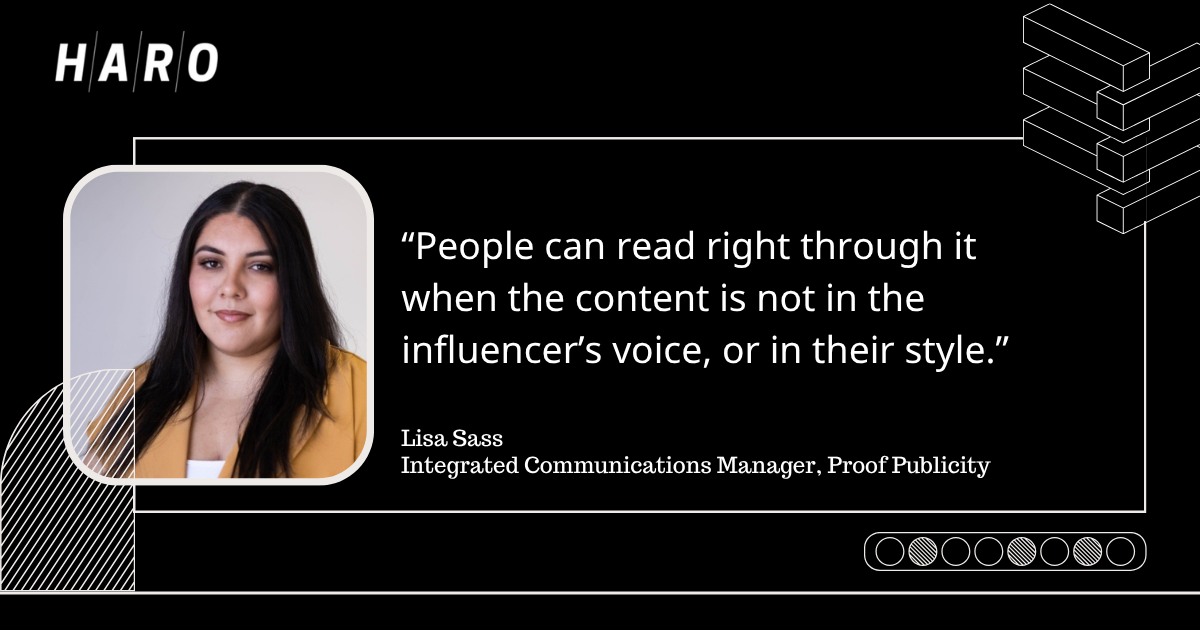
Lisa Sass, integrated communications manager at Phoenix-based Proof Publicity, says that the days of posting “aspirational content” on social media are gone. Instead, she says that social media viewers today want authentic content and real-life experiences, which is why PR professionals are now briefing influencers like assignment editors.
“We’re asking influencers to build a guide, like providing a roundup of the best rooftop bars or producing a how-to tutorial, and not just a vibe,” said Sass. “It’s the content you used to see in Phoenix Magazine. But now, it’s on social media from influencers.”
Sass notes that the strategy of commissioning influencers requires some education, where PR provides talking points like you would with a journalist. However, she cautions that education has to be shared carefully so that the content created by the influencer doesn’t seem paid or fake.
YouTube collaborations with creators
A.J. Ricci, publicist at New Jersey-based Social Wise Communications, connects clients and YouTube creators to collaborate on aligned messages. Ricci spends time consuming media, identifying creators in the space who produce quality content, and reaching out to them to see if they’d be interested in a non-paid collaboration with his client.
“You really have to dive past content they’ve made and into what their credentials are,” said Ricci, when asked about best practices for YouTube creator collaborations. “Are they speaking about real issues that really matter to people? Are they doing it in a way that’s responsible, in terms of fact checking before putting material out there? It’s on PR to find the creators who are good and are doing good work.”
While many YouTube creators only offer paid collaborations to get a client’s message out, it’s the job of publicists to find the earned opportunities that lead to a mutual win for both the creator and the client. When well executed, the outcome is an authentic message that reaches a broad audience.
Product seeding, placement + distribution
PR is about getting your product in the hands of customers. Especially books.
Alex Strathdee, founder of Shelf Life, a San Diego-based book marketing firm, has worked on 1,000+ nonfiction books and spent over $10M on campaigns to get books into the wild. From monitoring the HARO Gift Guide section to running Goodreads Giveaways to sending cold InMails and emails to influencers and microcommunities, Strathdee aims to get 10,000 books into the hands of readers to effectively market a book.
“A book is only ever going to take off if a real person opens it and starts reading it,” said Strathdee. “Effective PR is finding the cheapest way for your target audience to see and experience the product.”
Product seeding isn’t just reserved for books. The strategy can be applied to most consumer products or B2B subscriptions, and it’s a strategy that PR finds itself doing more and more. The key, according to Strathdee, is executing cost-effectively while reaching the exact right audience.
VI. Winning the AI answer
An AI-generated answer is now a brand’s most important search result. PR has built an entire discipline around “machine relations” to influence what the machines summarize.
Controlling the narrative for brand reputation
AI surfaces information about brands, whether they like it or not. Oftentimes, the information isn’t accurate, may be out of date, or in some cases, just isn’t what a brand wants surfacing about itself.
Ann Rimkus, executive vice president of strategy at POINT, a mid-size PR agency in Dallas, says that brand reputation work is now a focal point for clients. Whether it’s a Reddit thread that’s out of date or a story that just can’t be buried, there’s a strong push to help control the narrative and message that’s cited by AI.
“We’re seeing progressively more people turn to agents to get information on a search,” said Rimkus. “Agents are often pulling information that may not be current, or may not be correct. That’s why brands are now in a situation where they need to control the narrative.”
Controlling the narrative starts with an audit to figure out what’s being surfaced about a brand. Then, it’s figuring out what the narrative should be, and deciding which channels a message needs to be distributed on. Finally, it’s pushing out those messages in content forms like a press release, long-form blog content, and podcasts to make sure there’s a consistency around the brand.
Prompt research
What’s getting searched in AI models? What’s getting cited? Answers to those questions start with “prompt research,” a task that is at the intersection of AI in PR.
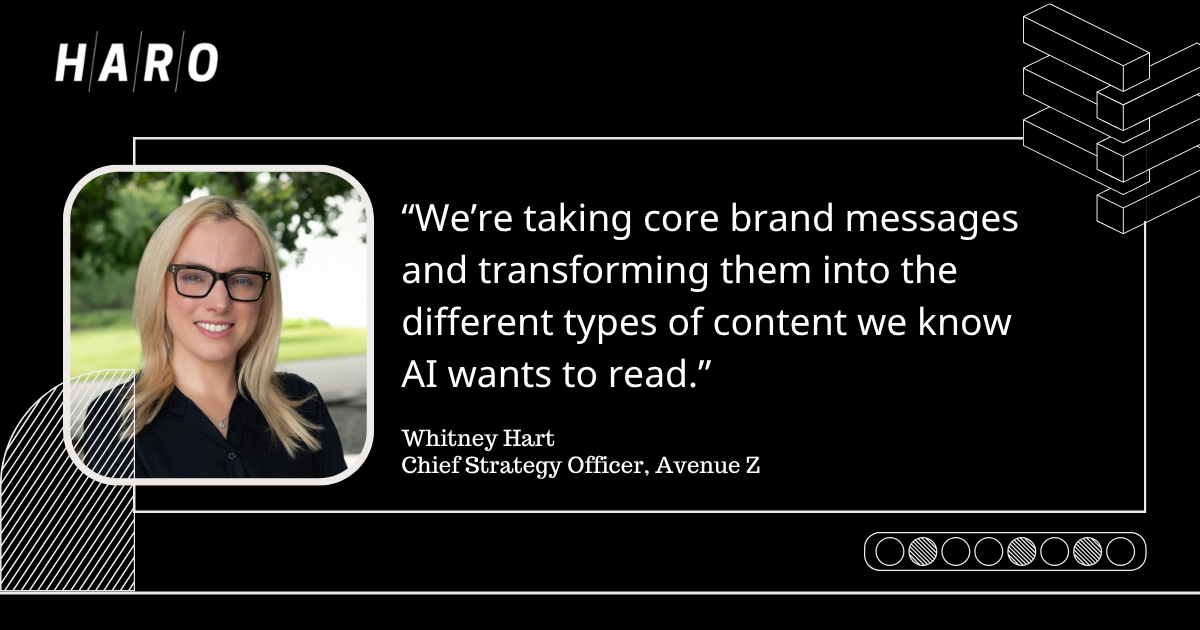
Whitney Hart is the chief strategy officer at Avenue Z, a marketing and communications agency, where she leads strategy around AI search visibility, brand positioning, reputation, and communications. Hart and her team have treated AI models as a new form of ICP (ideal customer profile), doing research on prompts on various platforms ranging from Profound to Peec, where her team is looking at fan-out queries and determining what content might get cited based on existing results.
“When you type a prompt into ChatGPT, the AI is then going and searching twenty other things before it comes back and gives you an answer,” said Hart. “We’re looking at those secondary research topics, and how it relates to what the original prompt set should be. We find that for most clients, anywhere between 30% and 45% of prompt answers come from editorial and earned media.”
Earned media, it seems, is a very important tactic for influencing what the LLMs say about you and your brand. While prompt research can help guide efforts, Hart is quick to point out that the space is evolving and changes day to day.
Reverse engineering answer summaries
The one consistency in AI answer summaries?
Inconsistency.
What appears and gets cited in an answer summary for one AI model like Perplexity may differ from what appears in Gemini or ChatGPT. What gets reported in one AI visibility tool like Profound may go missed in a platform like Peec or Scrunch.
The same goes for a PR practitioner doing their own research. What a PR practitioner searches on their computer may differ from what a client sees, based on factors like location, user preferences, and recent model rollouts or updates.
That’s why PR practitioners like Jennifer Harrison of Pando Public Relations are investing time in reverse engineering answer summaries. Harrison is accumulating data from queries across various sources, so that more raw data better informs her implementation.
“I just wrapped up a report with 13,000 data points against 30 queries,” shared Harrison. “Now I have exact marching orders for the terms I need to be mapped, and which outlets to go after.”
PR is doing raw data analysis to know where the gaps are in its AI visibility strategy — and to generate a custom plan on where to execute.
Research and development on what works
What if you found out that YouTube views don’t factor into being cited by LLMs? Or that getting a placement on a small travel blog out of Spain would be more valuable than a placement on National Geographic, Mashable, and CNN — combined?
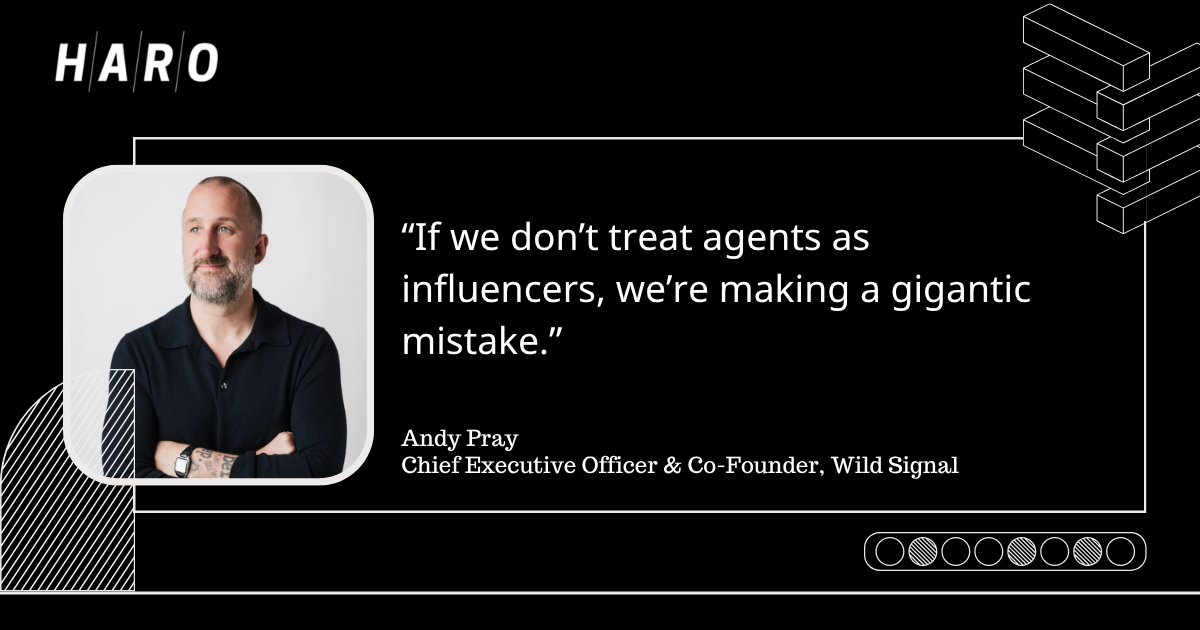
Andy Pray has been in the R&D lab more often than not as he’s gone to market with his new public relations agency, Wild Signal, an AI-native studio built at the intersection of GEO and earned media. Wild Signal asks LLMs hundreds of questions, thousands of times, then studies what comes back: everything from the sources they trust, the stories they repeat, the partners with authority, and the gaps no one has claimed yet.
“If you want, you could pitch 500 outlets. Or, you could run the data and focus your efforts on pitching the 10 biggest authorities for your target questions,” said Pray. “I guarantee those 10 authorities are not what the typical media list looks like. The list will likely have three hidden gems, four sleepers, and three kingpins. Our data shows that getting two or three placements of those 10 targets is as good as getting 10 placements of the next 30.”
Data allows PR professionals to work smarter and more efficiently, so that creativity can be unlocked and applied to campaigns. That’s why PR is now doing R&D.
While many view PR as all things that have to do with words, most practitioners are assuming more of a data-centric and quantitative role in order to better guide their outreach.
Optimizing content for AI answers
Pilar Lewis just wrapped up a 16-month case study of her own internal PR efforts that tracked 166 media placements. She found that 84% landed in outlets with measurable AI visibility in LLMs, a metric tracked by Muck Rack.
Her secret to optimizing content? Breaking it down into citable elements for machines and readers alike.
“AI visibility wasn’t a metric I was thinking about in PR reporting two years ago,” said Lewis, senior public relations associate at Marketri, a B2B marketing consultancy. “Now it’s something I’m building into every campaign brief.”
Lewis is quick to point out that optimization is evolving, where what works today may not work tomorrow. However, PR practitioners can experiment with optimization today by publishing question-and-answer content and revising pages to have clear headings with structured content that follows.
The earned-to-owned ecosystem
PR’s job hasn’t changed: earn trust and credibility for brands. The way the job gets done has changed. No longer is earning a placement in a media outlet the finish line that gets celebrated. Today, the placement is just the starting point.
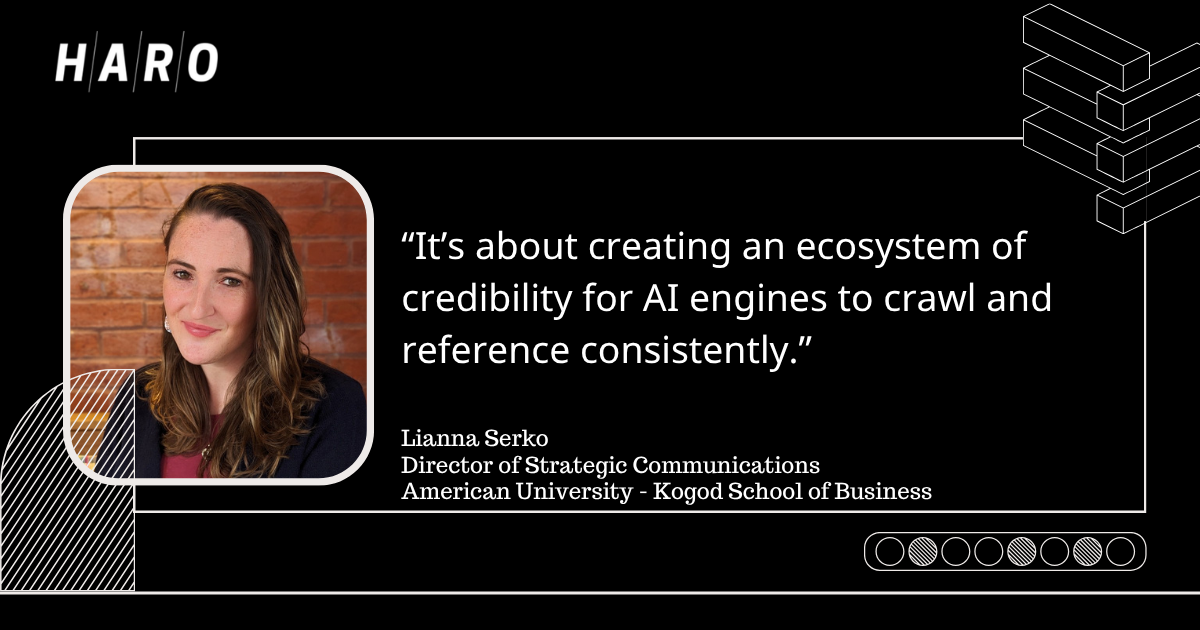
“Earned media is now the raw material for what we do next,” said Lianna Serko, director of strategic communications at American University’s Kogod School of Business. “One earned placement fuels our owned ecosystem.”
Serko’s owned ecosystem is circular and extensive, all designed to optimize for AI. The system takes something like a media hit and creates owned content structured for AI discoverability with schema and citations. Same goes for a podcast appearance with a subsequent conversation transcript — everything is fuel that can feed an ecosystem of credibility.
It’s now PR’s job to make sure the organization and its stakeholders appear in AI summaries. Leaders like Serko are finding success in developing a circular system with structured pillars that hold up the ecosystem.
The press room
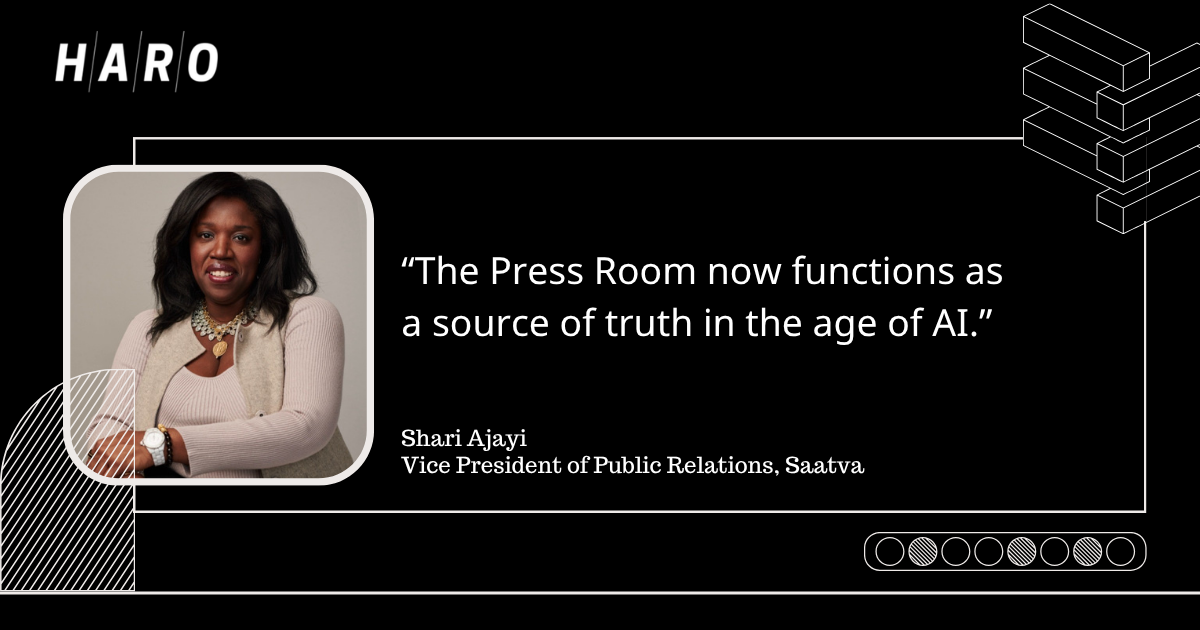
According to Shari Ajayi, vice president of public relations at Saatva, a restorative luxury sleep company, the press room is no longer a place to dump press releases. It’s now the source of truth for a brand, and the way to communicate with AI and journalists.
“The press room is helping power our citations and mentions, and it’s impacting how people see Saatva in the age of AI search,” said Ajayi. “Publicists now interface more with the consumer because their content is now being served direct to the consumer in a way that we had never imagined.”
Ajayi added that a good press room not only has content, but also thought leadership profiles that are structured for citations. Saatva has 20 thought leaders with profiles, ranging from the CEO down to an in-house expert in supply chain management. Journalists want unique sources for stories, and a profile page enables brands like Saatva to showcase those earned media mentions — as well as extend the life of those mentions.
PR professionals always knew a press room was built for media to understand a brand and its products. But now, the press room is a place that exists to serve bots that can boost stories, brands, and revenue.
Creating media resumes
Podcast views don’t matter. It’s what you do with the podcast placement that does.
That’s the argument that Mickey Mikkelson, owner of Creative Edge Publicity, has placed at the forefront of his author PR agency. Rather than market books, his focus is on building the media resumes of the authors he works with.
“When NBC looks at the website of one of our authors, I want them to see that they’ve been interviewed in all these places and have interview experience,” said Mikkelson. “Some podcasts will have 12 views. But my mantra is that reach doesn’t matter, because we’re going to be taking that podcast appearance and sharing across our social media circles. It’s about building the media resumes of our clients.”
The CTA? Whether you’re a business executive or aspiring author, building your media resume online can inform both readers and AI on who you are, what you’ve done, and where you’ve appeared — in order to amplify your impact.
VII. Proving the work
Measurement has shifted from counting clips to proving business value. AI visibility is taking center stage on the reports PR carries into the boardroom, while placements and reach still matter.
The media tracker
The old saying goes, “What gets measured, gets done.”
PR professionals are tracking and measuring everything from the number of pitches and placements to journalist follow-ups and introductions. For Janae Bowens, founder of Social Inspiration, LLC, this meant building her own media tracker in Claude.
“PR folks need to know that they’re on the right track, especially for someone like myself who’s never worked for myself before,” said Bowens. “I need those wins to build confidence and keep pitching clients and myself to prospective clients.”
Bowens tracks media placements and media outreach to stay organized and on top of follow-ups. She has 62 entries so far, and keeps the tracker updated with daily progress and natural language prompts to help keep her and her business moving.
Part personal progress. Part client reporting. Part motivation. Some PR work in 2026 is necessary admin work.
Metrics + reporting
Many people who aren’t familiar with public relations may have a similar starting point:
“We want to get featured in The Wall Street Journal or TechCrunch.”
Expectation setting has long been a part of PR, as has communicating the value of a placement outside of a Tier 1 publication. That’s why it’s often necessary to have a defined metric system that helps quantify the value of a placement.
“We developed a proprietary system called PRISM that is based on seven weighted elements of coverage,” said Amy Roberts, vice president of communications at Sōvyn (formerly KNB Communications). “PRISM measures the true value of every placement. This tangible score allows our clients to better understand the impact of each placement rather than relying on traditional vanity metrics.”
As one Reddit user recently quipped in /r/publicrelations, 40% of a job in public relations is proving that the job was done. Metrics and reporting systems allow PR professionals to move from “Did you do your job?” to “What did the job do?”
Data analytics across multiple platforms
Reporting has always been required of PR. Now, with stronger data and fewer vanity metrics available, the expectation of PR is to produce “board-ready reports.” To get that data, PR professionals are now diving into dashboards across Google Analytics, Google Search Console, and a variety of social media platforms like LinkedIn.
“Reporting has always existed as a long, laborious process,” said Mike Emerton, founder of Bridgeview Marketing, an integrated tech PR and marketing firm based in Portsmouth, New Hampshire. “The answers reside in many separate data silos. Now through the help of AI, you can extract information and correlate it to the questions clients ask.”
The questions PR is being asked by clients and boards of directors alike range from “What’s the value of a media placement today?” to “How is the company showing up in AI answer summaries?” According to Emerton, it’s now the responsibility of PR professionals to set up data collection across multiple platforms and leverage the analysis and metrics available to help executives understand the value of PR.
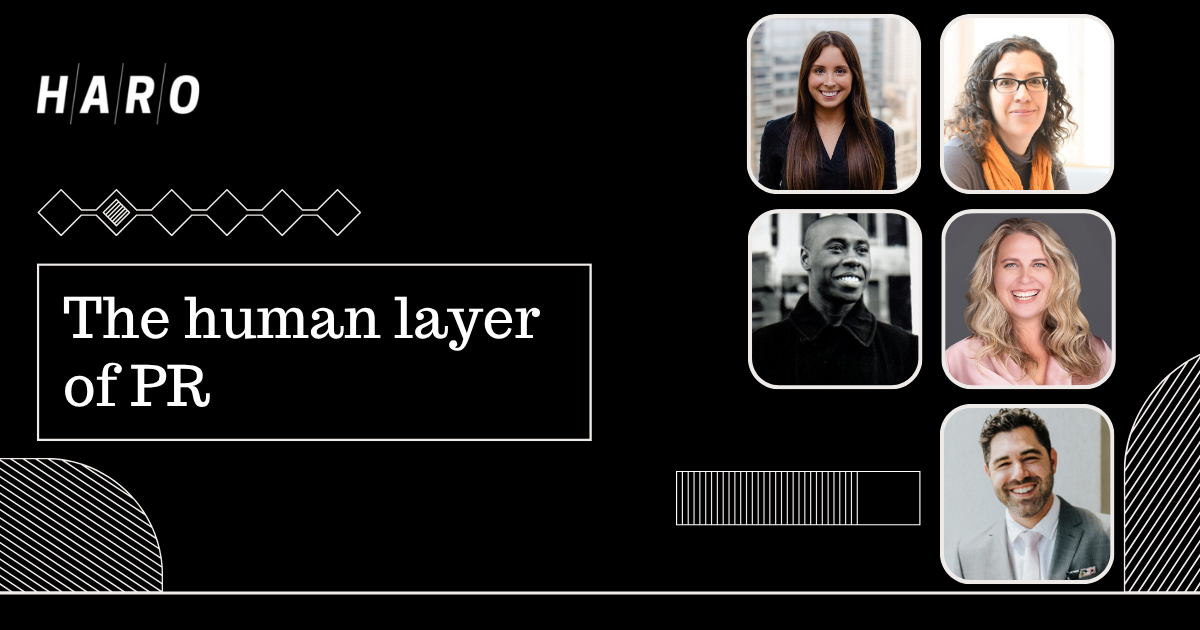
VIII. The human layer
Human judgment, making phone calls, having an in-person presence, developing genuine relationships with journalists. PR’s differentiator is everything AI can’t do.
Human judgment
PR is faced with tough strategy questions every day. What creators to work with? Where are competitors getting traction? Where’s the opportunity?
According to Paul Wilkie, founder of Golden State PR, a micro PR agency for consumer technology and audio companies, PR shines when it comes to providing “human judgment on strategy.”
“PR really does come down to just having great judgment about the audiences that you’re going for and making informed decisions about how to reach them,” said Wilkie. “It’s finding the best voices to say the message, to the people you think are most interested.”
As the options to reach audiences have expanded and become fragmented, Wilkie argues that human judgment has become more important. With limited time, resources, and effort, PR professionals need to frequently make judgments about channels and content.
Social media, or traditional written editorial? Video, or audio-only podcasts? Creators on Instagram, or TikTok? Offer the exclusive?
LLM as a judge? Negative. PR is the best judge for this type of work.
Picking up the phone and calling
The inbox has gotten out of control. Journalists change their email addresses and have multiple emails — the one they use publicly, the one they use for work, and the one they give out privately to their most trusted contacts.
AI slop seems to clog the inbox to the point where email can feel unusable. Smart PR professionals are shifting communications to a multi-channel approach, sliding into Instagram DMs or sending a LinkedIn InMail.
Or, if you’re Sarah Russo, picking up the phone. Even if it’s just to leave a message.
“We have some team members who have been doing this for a decade, and they’ve never had to pick up the phone. It just hasn’t been a thing,” said Russo, the founder and CEO of Page One Media, a literary public relations firm. “But the reality with pitch bots is that you are one of thousands of emails today. It’s time to pick up the phone again.”
PR professionals who have been in the industry for a while remember making phone calls. Now, it’s time to relearn those skills and get back to dialing in order to stand out and make progress.
Returning to in-person, real-life events
Samantha Flynn senses that fatigue is setting in. AI fatigue. Influencer fatigue. People are craving something real, in real life.
PR has long hosted, planned, and produced events for clients. Flynn, founder of Chicago-based Junipr Public Relations, is seeing an influx of demand from clients to be a part of events. Especially local events aligned with community.
“PR in 2026 is meeting people where they’re at,” said Flynn. “All of a sudden people want to be connecting in real life. We’re finding that local events are amazing for brands to connect with their target audience.”
Flynn shares that brands don’t always have to create and host an event. Sometimes brands can be a part of an event, and ride an existing wave on the path to building your “event DNA.” Just make sure to capture the event data, whether that’s a QR code, newsletter signup, or another way to continue the conversation beyond a bottle opener giveaway.
Building relationships with journalists
Hasn’t public relations always been about building relationships with journalists?
Well, yes. But now relationship building is more important than ever.
Why? As media gets fragmented, journalists who were typically at The Washington Post are now running their own Substack or writing for multiple other publications. Or, journalists who typically cover a specific beat are now assigned to write a story off their beat because there’s no one else at the publication who can take on the assignment.
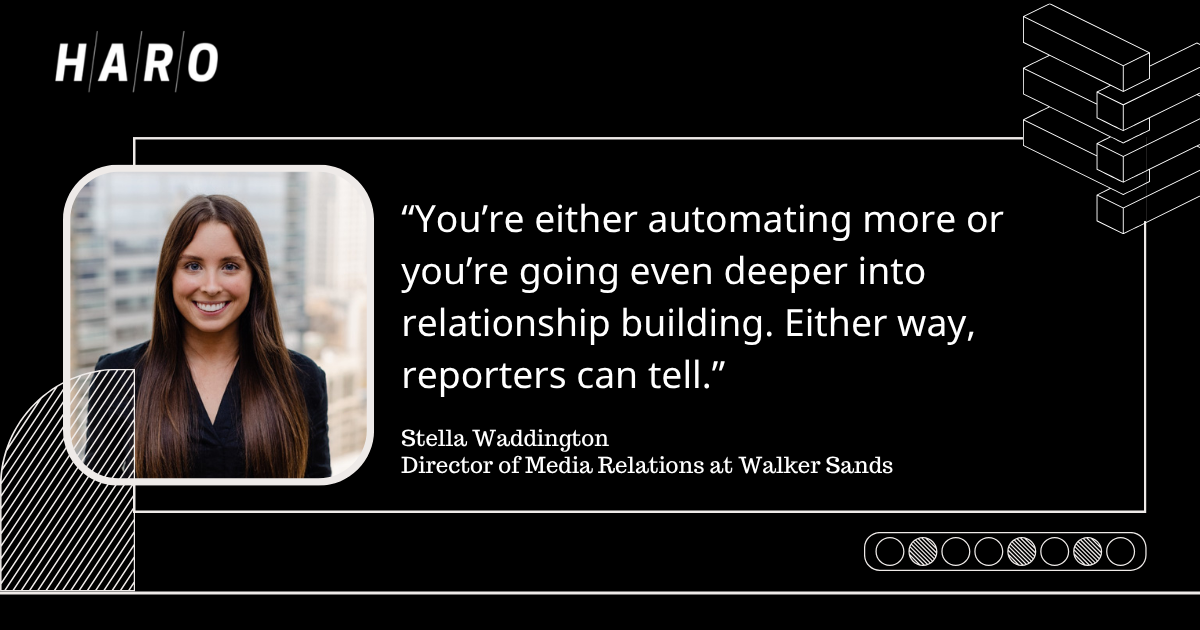
Stella Waddington, media relations director at Walker Sands, says that building relationships with journalists is where her agency has gone all in during this time of change.
“Relationship building with reporters is not just a nice-to-have,” said Waddington. “Today, if you don’t have a solid relationship building strategy in place, then media relations won’t work.”
How does PR build relationships? It’s about meeting a journalist where they’re at, and treating people like people. When a journalist posts on Substack or LinkedIn, appears on a podcast, attends an event, publishes a new article, puts out a HARO query — it’s about being there and ready to engage.
Relationship building has gotten noisier and harder to do. But it’s what separates PR agencies as the space splits between relationship builders and full-on automators.
Integrating + connecting it all
If the world is more fragmented than ever, PR is also about stitching it all together. It’s about getting executives, marketing, IT, and other departments aligned on a core message that’s been pressure-tested. It’s about ensuring that distribution takes into account the many fragmented possibilities of outreach and puts them together into a collaborative puzzle.
Tim Gibbon, founder of Elemental and former Omnicom executive who worked with the likes of Disney, stressed the importance of PR serving as a connector — linking world news to brands, brands to a message, and the message to creators.
“I always look at PR from an integrated point of view,” said Gibbon. “It all only really works when all the things are working together.”
From internal to external, to offline and online, from start to finish, PR is there for it all in 2026.
Frequently asked questions
How has AI changed public relations?
AI has changed both where PR works and how it is measured. Answer engines like ChatGPT, Gemini, and Perplexity now shape brand perception, so PR teams run prompt research, optimize content for citations, and track AI visibility alongside traditional placements. At the same time, AI-generated pitching has flooded journalist inboxes — making human relationships and judgment more valuable, not less.
What is GEO in public relations?
GEO (generative engine optimization) is the practice of making content more likely to be cited in AI-generated answers. In PR, that means earning coverage in outlets that LLMs trust, structuring owned content with clear headings, schema, and question-and-answer formats, and building the citation trail answer engines use to establish credibility. It overlaps with AEO (answer engine optimization); both target visibility in AI answers rather than traditional search rankings.
Is earned media still worth it in 2026?
Yes — arguably more than before, because earned media now does double duty. A placement reaches the outlet’s human audience and simultaneously becomes a citation that influences what AI models say about a brand. One 16-month study cited in this article found that 84% of media placements landed in outlets with measurable AI visibility in LLMs.
What skills do PR professionals need in 2026?
The modern PR skill set pairs data fluency — prompt research, analytics, and AI-visibility measurement — with the durable human skills machines can’t replicate: news judgment, storytelling, relationship building, and the willingness to pick up the phone. Practitioners increasingly describe the job as quantitative and strategic rather than purely word-driven.
How do you measure PR success in 2026?
Vanity metrics have given way to business-value reporting. PR teams track placements, share of voice, AI visibility in answer engines, and referral traffic across dashboards like Google Analytics and Google Search Console, then translate the results into board-ready reports that answer what a media placement is actually worth.
What isn’t PR in 2026?
What is PR in 2026? What isn’t PR in 2026?
As we’ve seen through the lenses of many different PR professionals, public relations isn’t just one thing. It’s everything, in an industry that’s evolving with every AI model update.
If all the short-term advancements and changes feel overwhelming to a PR practitioner, perhaps there’s something to learn from longevity.
Devon Blaine, who has owned and operated The Blaine Group, a Beverly Hills-based full-service communications agency, for 51 years, put it this way: “The job is to distill a message that’s newsworthy. There’s almost always a way to tell a story that works for most people. It just takes creativity,” she said, before adding this spin to her own story:
“I really love what I do, almost all the time.”